Showing posts with label Cronyism. Show all posts

Thursday, January 22, 2015

Kill the Jones Act; Kill It with Fire; Kill It Now

My latest in The Federalist (with help from an anonymous friend in the shipping industry):

Lost in the never-ending debate about the KeystoneXL pipeline is great news for anyone who opposes cronyism and supports free markets and lower prices for essential goods like food and energy. Sen. John McCain has offered an amendment to repeal the Merchant Marine Act of 1920, also known as the Jones Act, which requires, among other things, that all goods shipped between U.S. ports be transported by American-built, owned, flagged, and crewed vessels....  
The Jones Act and its related statutes raise the cost of essential goods for American families and businesses; strangle the life from the industries they were designed to protect; jeopardize U.S. maritime security; and exacerbate the pain of major national emergencies. (They also are major irritant in foreign trade relations.) So why hasn’t Congress repealed these laws? Maybe we should ask the politicians and well-connected cronies who benefit from the current arrangement. I’m sure they’d be happy to explain.  
McCain’s amendment to repeal the Jones Act is a common-sense solution to the problems facing a key American industry and the pain of the U.S. economy. The amendment, as well as any broader proposal to kill off the Act, deserves widespread support from conservatives and liberals alike. Efforts to dispense with this archaic protectionist boondoggle will no doubt meet fierce resistance from entrenched interests, labor unions, and opponents of free trade. However, those same groups stand only to benefit from efforts to make the U.S. fleet more competitive and less costly. American mariners have what it takes to compete on a global scale, and they should be given the chance. More competition translates to more opportunity, and perhaps the expansion and revitalization of a crucial sector of our economy. Where artificial monopolies and ancient restrictions can be removed, American labor, American business, and American consumers will have a chance to thrive.
Be sure to read the whole thing.

Senator McCain took to the Senate floor today to support his amendment and oppose the Jones Act. The text of his rousing speech is here, and video's below - definitely worth your time, and not just because the Senator entered my piece into the Congressional Record at the right at the end (sadly, not on video):


Fun.


Tuesday, April 22, 2014

Archaic US Trade Policies Inflate Gas Prices, Enrich Cronies

Cross-posted on Cato's blog:

The summer driving season is still weeks away, but rising U.S. gas prices are already back in the news.  Last week, the average price for regular gasoline at U.S. gas stations hit $3.6918 a gallon – the highest since March 22, 2013 and up 43 cents this year.  Much of this price depends on global supply and demand, but certainly not all of it.  In fact, two archaic, little-known U.S. policies – vigorously defended by the well-connected interest groups who benefit from them – restrict free trade in petroleum products and, as a result, force American consumers to pay considerably more at the pump.

First, the Jones Act - a 94-year-old law that requires all domestic seaborne trade to be shipped on U.S.-crewed, -owned, flagged and manufactured vessels – prevents cost-effective intrastate shipping of crude oil or refined products.  According to Bloomberg, there are only 13 ships that can legally move oil between U.S. ports, and these ships are “booked solid.”  As a result, abundant oil supplies in the Gulf Coast region cannot be shipped to other U.S. states with spare refinery capacity.  And, even when such vessels are available, the Jones Act makes intrastate crude shipping artificially expensive.  According to a 2012 report by the Financial Times, shipping U.S. crude from Texas to Philadelphia cost more than three times as much as shipping the same product on a foreign-flagged vessel to a Canadian refinery, even though the latter route is longer.

It doesn’t take an energy economist to see how the Jones Act’s byzantine protectionism leads to higher prices at the pump for American drivers.  According to one recent estimate, revoking the Jones Act would reduce U.S. gasoline prices by as much as 15 cents per gallon “by increasing the supply of ships able to shuttle the fuel between U.S. ports.”

Some of these costs could potentially be mitigated if it weren’t for the second U.S. trade policy inflating gas prices: restrictions on crude oil exports.  As I wrote for Cato last year, current U.S. law – implemented in the 1970s during a bygone era of energy scarcity and dependence – effectively bans the exportation of U.S. crude oil to any country other than Canada.  Because U.S. and Canadian refinery capacity is finite, America’s newfound energy abundance has led to a glut of domestic oil and caused domestic crude oil prices (West Texas Intermediate and Louisiana Light Sweet) to drop well below their global (Brent) counterpart.  One might think that this price divergence would mean lower U.S. gas prices, but such thinking fails to understand that U.S. gasoline exports may be freely exported, and that gasoline prices are set on global markets based on Brent crude prices.  As a result, several recent analyses – including ones by Citigroup [$], Resources for the Future and the American Petroleum Institute - have found that liberalization of U.S. crude oil exports would lower, not raise, gas prices by as much as 7 cents per gallon.

Thus, the Jones Act and the crude oil export ban – each implemented decades ago – together inflate U.S. gasoline prices by as much as 0.22 per gallon – or about 6% of the current price at your local gas station.  Not everyone in the United States, however, is harmed.  In the case of the Jones Act, the American shipping unions and shipbuilders that benefit from the law have long opposed any type of reforms, regardless of the pains imposed on the American economy and U.S. consumers.  The crude oil export restrictions, on the other hand, have found new support from a small group of U.S. refiners who profit handsomely from depressed domestic crude prices and the lack of any legal limits on their exports.  As is always the case with protectionism, these groups win and U.S. consumers lose.

Given this political dynamic, reform of either law appears unlikely in the near future, regardless of how dramatically the U.S. trade and energy landscape has changed since the laws were imposed.  So the next time you fill up the tank, note that about 6 percent of your bill pads the bottom lines of a few well-connected cronies.

Saturday, April 13, 2013

So USDA Is Pondering a "Sugar-for-Ethanol" Program. No, Really.

From earlier this week comes news of what could quite possibly be the most cronytastic US government program of all time:
The White House will decide in coming weeks whether to attempt to blunt low prices in the U.S. sugar market by buying hundreds of thousands of tons of surplus sugar and selling it at a loss to ethanol makers.

If approved, it would be the first time the sugar-for-ethanol program, created in 2008 and known as the Feedstock Flexibility Program, has been put into operation....

Large crops in the United States and Mexico have pushed New York futures prices below the trigger price for potential forfeiture by processors of sugar to the government.

The sugar is used as collateral on USDA price-guarantee loans.

Forfeitures could begin in July, with the expiration of USDA loans that guarantee growers will get at least 20.94 cents per lb for sugar. The remainder of the loans expire in September.

"We're doing it because it's the law," U.S. Agriculture Secretary Tom Vilsack said on Monday at the North American Agricultural Journalists meeting. The tonnage purchased "is still not decided," he said....

The 2008 farm law directs USDA to make surplus sugar available to ethanol makers, a provision penned in the early days of the biofuel boom with the goal of creating feedstocks in addition to corn.

"The law makes the Feedstock Flexibility Program the first line of defense. The other main option is to reduce the volume of imports through negotiation or by buying back certificates of quota eligibility," said Tom Earley, economist and trade policy specialist with consulting firm Agralytica.

Some $864 million in loans was in danger of forfeiture, by one estimate. The USDA forecasts the sugar stockpile at the end of this marketing year at 2.4 million tons.

At 20 percent of annual use, it would be the largest carryover since 2001. The USDA will update its forecast of the sugar surplus on Wednesday....
So a 2008 law forces USDA to (i) subsidize US sugar growers by buying their product at above-market prices and then (ii) subsidize US ethanol producers by selling them the exact same sugar at below-market prices.

Ladies and Gentlemen, the United States Government.

On a more serious note, insanity like this provides a perfect example of why it's just so darn tough to eliminate US subsidies - politicians shilling for the sugar growers form an unholy, subsidy-loving alliance with their colleagues shilling for the ethanol (mostly corn) producers. These "public servants" concoct mutually-beneficial programs like the "Feedstock Flexibility Program" to line their cronies' pockets, and they agree to oppose any attempts to trim those programs or any other subsidies that they've secured.

They win; taxpayers (and markets) lose; rinse; repeat.

Wednesday, August 8, 2012

Umm, Yeah, About Those Amazing Chinese Solar Subsidies...

Over the last several years, China's subsidization of its domestic solar panel industry has attracted ire and envy in the United States.  Bankrupt US solar producers and the US politicians who subsidized them have been quick to deride pernicious Chinese subsidies - rather than their own corporate or policy mismanagement - as unfairly creating a global export juggernaut that has doomed their business.  I've already discussed the US Department of Energy's 2011 "blame China" parade following Solyndra's collapse, and it appears that Abound Solar and its political champions are following suit:
Abound Solar filed for bankruptcy earlier this month, succumbing to intense competition from China that has sharply driven down the cost of solar panels, said Thomas Tiller, who served as Abound's chairman.

Tiller said the Chinese government provided about $35 billion in subsidies to Chinese solar companies, resulting in sharp growth in production capacity that outpaced demand and pushed down the price for panels by more than 50 percent in just a year.

"Such a severe market change made it difficult for Abound and others to survive," he said in remarks prepared for a House of Representatives oversight committee hearing.

Prior to filing for bankruptcy, Abound received about $70 million of a $400 million loan guaranteed by the U.S. Energy Department.

The drop in the solar panel price was bigger than the Energy Department and other experts expected at the time the Abound loan was finalized, David Frantz, acting executive director of the department's loan program, said in prepared testimony.
Meanwhile, American industrial policy fetishists have been quick to note the dominance of the Chinese solar industry as proof that the US should have mirrored China and thrown even more taxpayer money at our solar panel producers.  For example, here's FP's Clyde Prestowitz throwing out a blatant I-told-you-so back in March of this year:
The solar panel industry was identified by the Chinese government long ago as a target of special attention. Indeed, I recall being in a White House meeting in 2009 to discuss the prospects for the U.S. solar panel industry. I told the administration's top economists then that unless they were prepared to match the enormous incentives China was planning to provide to its industry ,the U.S. industry would be blown out of the water. They weren't prepared to match and the industry is, in fact, now being blown out of the water. Anyone who had had the experience with Japan or who had an ounce of understanding of how strategic industry targeting and export-led growth works could have foreseen exactly what has come to pass as China has poured about $34 billion of subsidies into its industry which exports about 95 percent of its production. That would be the loss of several thousand U.S. jobs and the bankruptcy so far of 12 U.S. companies. This is not to mention the inevitable reductions in R&D spending and innovation in the face of the tsunami of imports from China.
Prestowitz, much like the US Steelworkwers union, appears to think that the billions in subsidies that the US government has thrown as American solar producers are woefully insufficient, and that just a few billion more would have all but guaranteed a globally-dominant US industry that's just brimming with profitability... you know, just like the, err, Chinese industry:
China’s top ten photovoltaic makers have accumulated a combined debt of 17.5 billion U.S. dollars so far, leading the whole industry to the brink of bankruptcy, data from U.S. investment agency Maxim Group showed.

LDK Solar, the world’s second-largest maker of solar wafers, and Suntech Power, the world’s largest solar panels producer, are the mostly likely to be headed for bankruptcy, Maxim noted....

Based on preliminary results of domestically traded photovoltaic companies for the first half, nearly 80 percent have slashed their earning forecasts while the top ten brands, listed overseas, posted a loss of 612 million U.S. dollars in the first three months this year.

Yingli Green Energy Holding Co., another leading solar power company in China, said over the weekend that the company cut its delivery growth forecast of photovoltaic modules from 15 percent to 13-14 percent for the second quarter, and gross margin from previous 4.5-4.9 percent to around 4.5 percent for the period.

“A gross margin of 4.5 percent indicates a loss, for sure, in the second quarter,” said Meng Xiangan, vice chairman of the Chinese Renewable Energy Institute. According to Meng, gross margins for China’s ten leading photovoltaic makers were all below 10 percent in the first quarter, led by Canadian Solar, who earned a gross margin of 7.7 percent but still reported a loss of around 20 million U.S. dollars. What’s worse, cash flows in Chinese solar makers are even tighter as many have rolled their debts over to 120 to 180 days, according to investment firm Helix Investment Management.
Gee, so what happened?  How could the subsidized Chinese juggernaut now be on the brink of disaster?  If only someone could have predicted this.  Oh, wait:
As tensions heighten over questionable subsidies and anti-dumping cases against China’s solar panel manufacturing sector, most non-Chinese citizens are quick to claim that China is robbing the industry from other countries. Indeed, China’s doubling of solar panel exports in 2009 and 2010 was followed by a string of bankruptcies of solar firms in other countries, including Germany and the US, in 2011. However, despite China’s huge gains in its global market share, its solar sector now likely faces a serious consequence of its explosive growth: overcapacity. Manufacturing capacity of solar panels is outpacing global demand, and as a result the prices of solar products have plunged; and now many Chinese solar manufacturers “face ‘suicidal’ prices on excess output” and are slashing prices in order to liquidate inventory.
So, it appears that all those Chinese (and American and European and...) subsidies have led to massive overproduction and a collapse in solar prices, and Chinese solar companies (and their global counterparts) simply can't stay afloat in the current market.  Of course, the current US antidumping and countervailing duty investigations of Chinese solar panel imports certainly aren't helping the Chinese industry's bottom line, but those cases very likely wouldn't have happened without all that sweet, sweet government cash to depress prices and make the industry vulnerable to anti-subsidy allegations.

Thus, the very subsidies that were designed to ensure Chinese solar industry dominance have helped cement its near-term demise (and brew up a couple trade disputes in the process).  Yes, the Chinese government might swoop in and "save" its ailing solar industry - it certainly has enough spare cash lying around to do so - but that salvation would come at a clearly huge expense.  The debt-ridden US government has no such "luxury," but considering the past few years of subsidized failures like Solyndra, Abound Solar and the rest, coupled with the experience of the super-subsidized Chinese solar failures, one must really wonder if maybe - just maybe - we're better off for it.

Monday, July 9, 2012

Great News: Cronyism Under Attack (UPDATED)

The last two days have seen a flurry of great writing on crony capitalism and its immense harms to the US economy.  Anti-cronyism watchdog Tim Carney - whose Washington Examiner page is an impressively depressing library of crony capitalist excess - kicks things off with a good summary of the recent conservative/libertarian uprising against the unseemly marriage of Big Business and Big Government:
The most dangerous enemies of capitalism today are capitalists. This is becoming clearer every day to people committed to free markets.

The conservative and libertarian grassroots came to deeply distrust big business after the Wall Street bailouts and Obama's stimulus and health care bills, both of which had big-business backing. Tea Party ire focused on subsidy-suckling businesses as much as at big-spending politicians.

Beltway conservatives have also joined in the fight against corporatism. Last spring, the Club for Growth, FreedomWorks and the lobbying arm of the Heritage Foundation all lined up against the Chamber of Commerce and pressed GOP congressmen to vote to kill the Export-Import Bank, which nonetheless was reauthorized by an overwhelming margin.

Republican politicians, despite being lobbied hard by their big-business donors and K Street advisers, are nevertheless moving slowly away from corporate welfare and toward free-market populism. House Budget Committee Chairman Paul Ryan wrote an op-ed in Forbes in 2009 titled "Down with Big Business" (a headline he borrowed from a 1979 Wall Street Journal op-ed).

And now academia's free-market players are getting in on the game, beginning to rebuild the intellectual infrastructure to argue against corporatism. George Mason University's Mercatus Center this week is kicking off a series of papers on cronyism and business-government collusion.
The first of those papers, "The Pathology of Privilege: The Economic Consequences of Government Favoritism" by Matthew Mitchell, was published yesterday.  Carney describes it as follows:
Mitchell's paper, drawing on the scholarly work of Milton Friedman, James Buchanan, Gordon Tullock, Joseph Schumpeter, Mancur Olson, George Stigler, Luigi Zingales and many others, outlines various types of privilege and lays out the evidence that these policies hurt the economy while benefiting the privileged.

Politically favored businesses of course benefit from direct subsidies (think agribusiness) and government loan guarantees (think Solyndra and Boeing), but Mitchell makes the important point that regulation itself creates a privileged class.

Regulation often acts directly or indirectly as a barrier to entry. The conservative and libertarian media have documented this anecdotally -- Philip Morris supported and is benefiting from Obama's tobacco regulation, for instance, because the rules allow it to lock in its dominant market share. Mitchell assembles scholarly work broadly showing regulation's anti-competitive and pro-big-business effects....

In the Obama era, as Democrats and the media try to paint deregulation as some sort of dangerous sop to big business, Mitchell's notion of "regulatory privilege" is a crucial tool for dismantling the old narrative that regulation protects the public....

The research Mitchell brings together helps show why government-granted privilege is so important to big business and so costly to the rest of society. In one key finding, he highlights research indicating that free markets, with fewer barriers to entry and fewer bailouts to prop up failed giants, make it harder for dominant businesses to maintain dominance.

Mitchell cites a 2008 study in the Journal of Financial Economics that found "big business turnover ... correlates with smaller government, common law, less bank-dependence, stronger shareholder rights, and greater openness [to trade]."

Further, in Mitchell's words, "those nations with more turnover among their top firms tended to experience faster per capita economic growth, greater productivity growth, and faster capital growth."

Big business wants safety, but big-business safety hurts the rest of the economy.
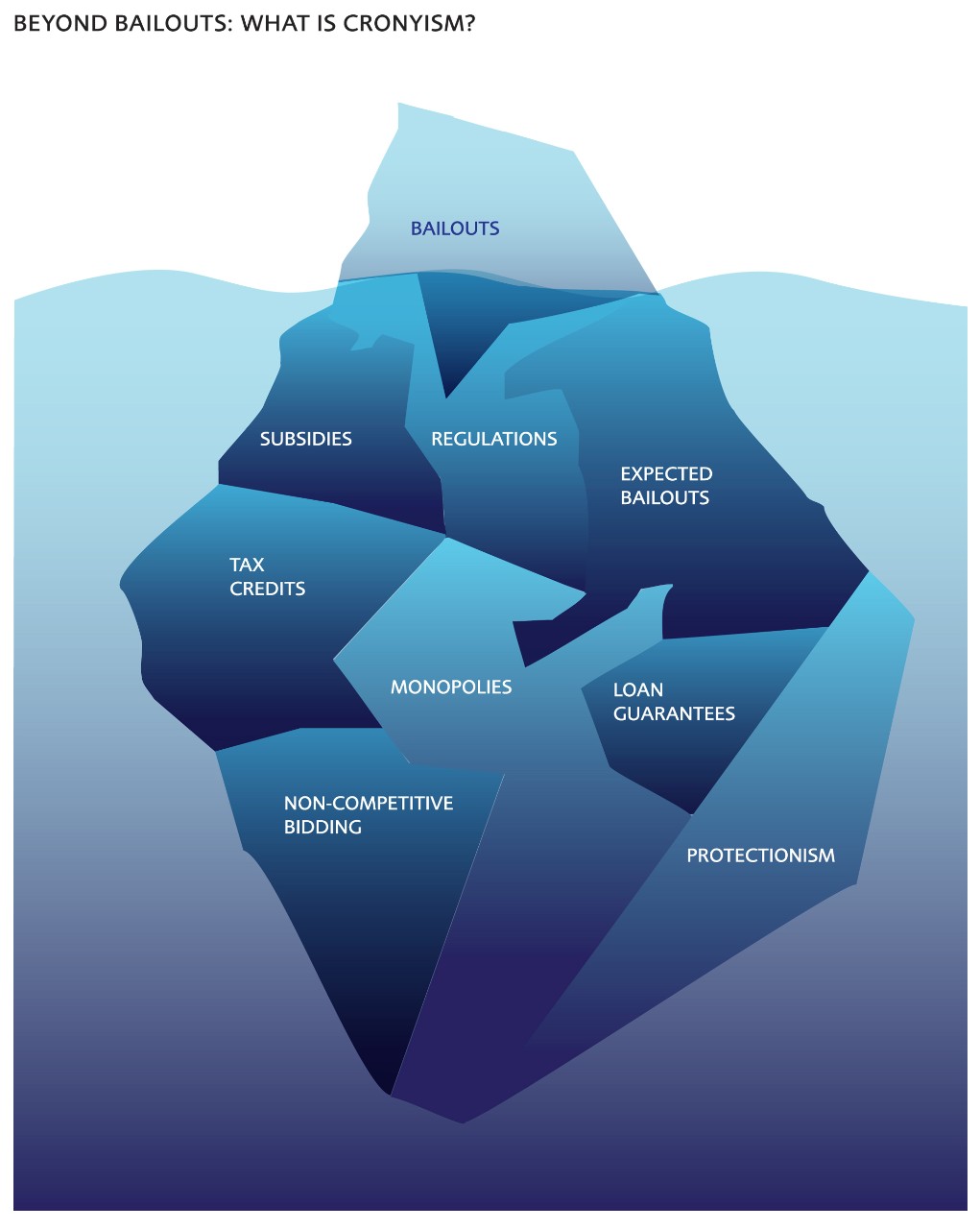
Mitchell follows up his paper with a great interactive graphic on all the forms that cronyism can take, several of which are routinely discussed on this blog:


I've long argued that protectionism is just another form of cronyism - a way that well-connected businesses and workers lobby the government to force US consumers to subsidize - via higher prices - their business activities, so it's great to see it included here.  My only quibble with Mitchell's description of protectionism in the graphic above is that, while tariffs have certainly decreased over the last several decades, trade remedies measures, regulatory protectionism (like the Lacey Act or Dodd-Frank's "conflict minerals" provisions) and other non-tariff barriers to trade have increased significantly, particularly in recent months.  Mitchell isn't blind to such measures and even mentions that they "may" have become more important over the last few years, but this troubling trend deserves more than passing mention.


But I'm clearly nit-picking.  The paper is great and well worth your time, so be sure to check it out.

Carney follows up his Sunday article with long list of recent examples of crony capitalism over the last few years.  Cato's David Boaz today hits on one such example that Carney misses, Countrywide home loans:
I was struck by this point in a Bloomberg report, about Countrywide CEO Angelo Mozilo’s close relationship with Fannie Mae chief executive Jim Johnson, former top aide to Vice President Walter Mondale and chairman of both the Brookings Institution and the Kennedy Center. Instructing his staff to give a discount mortgage loan to Johnson, Mozilo wrote in an email: "Jim Johnson continues to be a source of many loans for our company and this is just a small token of appreciation for the business that he sends to us."

Note that Jim Johnson didn’t favor Countrywide with his personal business. He didn’t invest in Countrywide. He didn’t sell houses and send the buyers to Countrywide. No, he sent loans backed by taxpayers’ money to Countrywide, and was rewarded with personal benefits. That’s crony capitalism....

Given his credit report, Countrywide underwriters didn’t want to sign off on a loan to Johnson. But Mozilo, who knew the business Countrywide was really in, told them not only to approve the loan but to give Johnson a discounted rate.

And that, kiddies, is how being involved with a highly respected politician can get you a job in Washington that pays $100 million, backed by the full faith and credit of the American taxpayers, as well as extra perks from other companies tied into the crony corporatist state.
Pretty awful stuff, and yet (as Carney's list highlights) such cronyism remains pretty widespread in DC on both sides of the aisle.

Speaking of, Heritage's Lachlan Markay gets in on the anti-cronyism action today by highlighting one of the most ridiculous aspects of the poster-child for bi-partisan trough-filling, farm subsidies:
The U.S. Department of Agriculture has doled out millions of dollars in subsidies to farms on which farming isn’t actually taking place, according a new report from government watchdogs. Billions more have gone towards supporting farms that don’t grow the crops for which they’re being subsidized.
Nice.  The latest version of the Farm Bill passed the Senate by a ridiculously large margin, and House votes begin this week.  Easy passage is expected there too... naturally.  Lord only knows what kinds of absurdities are buried in these things.

Citing the farm bill, AEI's Arthur Brooks argues in a new WSJ op-ed that the resurgence of crony capitalism is one of the main indications that the United States is heading down the inevitably-disastrous road of European social democracy:
The second force leading us down the social-democratic road is cronyism. America possesses a full-time bipartisan political apparatus dedicated to government growth and special deals for favored individuals and sectors. For example, the farm bill that just passed the Senate contains around $100 billion in subsidies, mostly for large, corporate farms that do nothing to improve nutrition or food security. Or witness the recently reauthorized Export-Import Bank, which doles out about $20 billion annually in corporate welfare.
Brooks concludes, however, that all is not lost for the country:
What is the answer? We caught a glimpse of it in 2010, when a movement of ethical populism—the tea party—mobilized millions of Americans to read the United States Constitution and demand politics that reflect the majority's values. And while woefully misguided in its diagnoses and policy solutions, the Occupy Wall Street movement was at least right to protest the malignant cronyism in our economy. That energy must re-emerge in 2012 and become a permanent part of our political landscape.

In 1787, Benjamin Franklin was asked what sort of government our new nation would have. His famous answer was, "A Republic, if you can keep it." When he said this he was envisioning a monarchist alternative, not today's noxious brew of leftism, cronyism and general inattention to public policy. But Franklin's maxim is still valid today.
Indeed it is. Fortunately, the recent attacks on crony capitalism from the grassroots, academia and, yes, even a few sitting politicians are most definitely a good sign that a growing number of us intend to fight to keep our Republic.

UPDATE: GMU today puts out a new primer on How Cronyism Is Hurting the Economy:

Wednesday, June 27, 2012

No Joke: US Export Promotion Effort Funded by... Taxing Exports

The Office of Senator Jim DeMint has done some worthwhile digging into the Obama administration's new US tourism promotion effort, "Brand USA," and what they've uncovered is actually more ridiculous than you'd expect.  The report's goal is to show that the new export promotion program - remember: domestic tourism is actually an "export" because foreign dollars are spent here on US goods and services - is rife with cronyism, over-spending and general mismanagement.  (The lede: "High-powered executives are enjoying luxury accommodations all over the world, all in the name of promoting tourism for the U.S. government." Yikes.)

Now, this news is certainly not good for US taxpayers, but let's face it: this type of stuff is unfortunately pretty commonplace in government and we're not talking about a lot of money here.  On the other hand, it's this seemingly-innocuous passage that caught my attention:
Established through the 2010 Travel Promotion Act, Brand USA is eligible to receive up to $100 million annually generated through new taxes paid by foreign travelers.
I freely admit that prior to today I had only a vague recollection that this Act - passed during the halcyon days of total Democrat control of the White House and Congress - even existed.  A little Googling reveals a snazzy Brand USA website and the text of the Travel Promotion Act, which was included as Section 9 in another bill reauthorizing the Capitol Police (no joke) and provides in subsection (d) for the establishment of a "Travel Promotion Fund" and then in subsection (e) for a "Travel Promotion Fund Fee."  The good folks at Global Trade Alert have summarized that fee as follows:
The law institutes a new fee of $10 or more on visitors traveling to the United States from the 35 countries that participate in the Visa Waiver Program (VWP) . This new tax is supposed to raise an estimated $200 million per year, which will be used to help fund a new “Corporation for Travel Promotion.” The purpose of this new corporation is to promote tourism to the United States.

The bill developed from the “Travel Promotion Act of 2009” (S.1023 as originally introduced...), a bill that would establish a program for the promotion of travel to the United States, and provide for two separate means of funding this program. One would be a fee of at least $10 on each traveler from certain countries that enter the United States, and the other an unspecified set of assessments on the travel industry in the United States. These fees might be inconsistent with the national-treatment principle of GATT Article III and (perhaps more appropriately) GATS Article XVII.
I'm certainly not going to get into the trade law weeds regarding the WTO-consistency of the Travel Promotion Fund Fees (although that is an interesting issue).  Instead, I just want to clarify that this is an actual US law that is designed to promote tourism exports by imposing a new tax on - and thus discouraging - tourism exports.

Seriously.

Now, I'm no mercantilist, but even I can see that if you want to encourage exports it's probably not a good idea to - you know - tax them.  (Then again, this is the same US government that imposed new taxes on imports in order to fund trade-liberalizing free trade agreements, so maybe they're just being consistent.)

This export promotion law becomes an even worse idea when we learn, as Senator DeMint's office helpfully informs us, that a good portion of these export taxes aren't even funding tourism exports but instead are helping, among other things, "CEOs from some of the nation’s most successful hotels and resorts... to book top-of-the-line venues to entertain other members of the travel industry."

So, really, we have an export tax that's bizarrely intended to promote exports but really just promotes the lavish expenditures of certain big exporters and, of course, the generous and helpful bureaucrats facilitating those expenditures.

You simply cannot make this stuff up.

(h/t Ben Domenech)