Communist-hating lovers of liberty have offered myriad reasons to oppose the current Cuban embargo (see, for example, here and here), but today I want to focus on the most basic: over the last two decades, the United States government has utterly failed to justify its forcible, legislated ban on Americans’ freedom of travel, contract, and commerce. Because we live in a country of natural rights and limited, constitutional government, the state alone bears a heavy burden of proving that its restrictions on individual liberty are in fact warranted. In the case of free trade, and especially freedom of movement, this means that there is a strong presumption in favor of Americans’ right to freely travel to wherever they want, and transact with whomever they want—one that may only be overcome where the state establishes a compelling interest in prohibiting or limiting those actions.Read the whole thing here.
Showing posts with label Unilateral Liberalization. Show all posts
Showing posts with label Unilateral Liberalization. Show all posts
Tuesday, December 23, 2014
Yes, Of Course We Should End the Cuban Embargo
My latest at The Federalist:


Wednesday, December 4, 2013
And Now for a Brief, but Important, Lesson on Trade Promotion Authority
Claude Barfield's latest piece emploring the GOP to advocate free trade has a great rejoinder to the persistent-yet-silly arguments from some on the right that Trade Promotion Authority is unconstitutional or unconservative:
Yet here we are, debating TPA and hoping against hope that somehow the President can complete new FTAs. That seems... misguided.
(p.s. Bill Watson's recent review of Republicans and TPA is also worth your time.)
Two arguments explain the incipient dissent: one, though not stated openly, is a reaction against giving any kind of victory to the Obama administration; and two, on more substantive grounds, broader constitutional arguments have been raised against TPA as ceding congressional power to the executive and eroding national sovereignty. As for the personal and political distaste for giving Obama a victory, opposition to TPA - and thus, by extension ratifying TPP and TTIP - for Republicans is akin to the proverbial "cutting off your nose to spite your face." Ultimately, a defeat for TPP and TTIP, if and when they come before Congress, would represent a defeat for longstanding Republican policies and principles and a victory for those elements of the Democratic party that are deeply suspicious of globalization and global free enterprise (The Elizabeth Warren wing of the party would be ecstatic).The whole Barfield piece is worth reading, so be sure to check it out. My only quibble: Republicans should support all forms of free trade, not just free trade agreements which require TPA. Indeed, as I argued recently, unilateral liberalization of US trade barriers is not only an economic no-brainer, but also a manifestly constitutional, conservative and moral policy that any fan of free markets and limited government (I think that still means Republicans) should strongly support. And, of course, my preffered free trade policy doesn't require messy reciprocal trade agreements, politically difficult TPA or the costly, Big Government things (*cough*TAA*cough*) that are so often attached to such measures.
On the constitutional questions, despite claims from anti-global activists on the left (and right: viz., Pat Buchanan and Clyde Prestowitz), conservative judicial experts have consistently defended the limited grant of authority on trade from Congress to the Executive as within the bounds of the division of powers envisioned by the Founding Fathers.
They make two points: first, through the TPA process, Congress exercises the power to dictate specific negotiating goals, and it mandates constant consultations with congressional leaders during the course of extended bargaining sessions. Second, and of paramount importance, Congress through TPA reaffirms that the provisions of trade agreement cannot force changes in US domestic law. Legislation implementing trade agreements all contain the following language:
"No provision of the Agreement...which is inconsistent with any law of the United States shall have effect." "Nothing in this Act shall be construed...to amend or modify any law of the United States...unless specifically provided for in this Act."
A decade ago when similar questions were raised about the constitutionality of similar trade legislation, two legal experts with impeccable conservative credentials - former Attorney General Edwin Meese and Judge Robert Bork - both endorsed the Executive-Legislative partnership on trade agreements. As Bork wrote at the time: "No treaty or international agreement can bind the United States if it does not wish to be bound. Congress may at any time override such an agreement or any provisions of it by statute."
As Meese and Bork affirm, US sovereignty and congressional prerogatives are not threatened by TPA or the proposed new trade agreements. Thus, Republicans should get on with the job of reaffirming their traditional commitment to open markets and vigorous international competition.
Yet here we are, debating TPA and hoping against hope that somehow the President can complete new FTAs. That seems... misguided.
(p.s. Bill Watson's recent review of Republicans and TPA is also worth your time.)
Thursday, October 31, 2013
New Article: "America’s Horrible, No Good, Messed-Up Trade Policy (and How to Fix It)"
[Ed. note: This article was first published in The Federalist, which you really should be reading by now.]
Americans currently pay high taxes on food, clothing, automobiles, industrial inputs and other goods and services, and their own United States Trade Representative is vigorously fighting other countries to keep it that way. Even worse, the government’s efforts all but ensure that removing such taxes – and easing the artificial burdens they place on American families and businesses – will remain unnecessarily, and irrationally, difficult for years to come.
Americans currently pay high taxes on food, clothing, automobiles, industrial inputs and other goods and services, and their own United States Trade Representative is vigorously fighting other countries to keep it that way. Even worse, the government’s efforts all but ensure that removing such taxes – and easing the artificial burdens they place on American families and businesses – will remain unnecessarily, and irrationally, difficult for years to come.
This is the awful state of American trade policy, and serious reform is long overdue.
Americans tend to think of the United States as some sort of free trade bastion in which unfettered globalization is – for better or worse – simply a way of life. However, while many U.S. tariffs were lowered decades ago, several tariff “peaks” remain in certain politically-connected areas like food, clothing, footwear and automobiles. Moreover, “non-tariff barriers” to trade – subsidies, regulations, etc. – have proliferated in recent years, and many “trade remedies” duties – based on allegations of “unfair” trade – also remain in place, particularly for industrial inputs like steel and chemicals.
The pros and (mostly) cons of these government measures vary, but one thing remains constant: their staunch and unflinching defense by the U.S. government in global free trade agreement negotiations. In these venues, gains are viewed as coming only from new access for U.S. exports and investment, while imports are the unfortunate price that America must pay for such “victories.” For example, as negotiations in both the Trans-Pacific Partnership (TPP) and the Transatlantic Trade and Investment Partnership (TTIP) gained momentum earlier this year, blubbering American journalists were quick to proclaim President Obama’s supposed “free trade renaissance” and strong support for expanding U.S. exports, but uniformly failed to report on the fact that his firm resistance to negotiating partners’ calls for lower U.S. trade barriers was a major reason for the agreements’ continuing difficulties. Nor did any such reports delve into the fact that those barriers, while certainly good for certain well-connected companies in the United States, injured the vast majority of American individuals and firms. And when TPP negotiators inevitably miss their much-ballyhooed and over-promised 2013 deadline for completing the agreement, you can bet that these facts will not receive top billing (or maybe even passing mention). Instead, only trading partners’ refusal to heed U.S. export demands will be blamed.
Trade and Reciprocity
The Obama administration, of course, is not the first to engage in such negotiating tactics and instead is simply the latest White House to do so. In fact, since the 1930s, American trade policy has utilized a “reciprocity” model of trade negotiations in which the United States treated any trade liberalization (e.g., the reduction of tariffs), no matter how smart or moral, as a “concession” that is only to be traded for another nations’ own acceptance of new U.S. exports or investment. Moreover, the diplomatic origins of the reciprocity model have ensured that trade liberalization is treated as a foreign, rather than domestic, policy area in which trade negotiations take on a zero-sum, war-like mentality where benefits are “won” or “lost”, instead of mutually achieved. Put most simply, exports are an unquestioned good to be pursued, while imports are an unmitigated bad to be resisted. Full stop.Even though U.S. foreign and domestic policy – as well as economics, politics and society more broadly – has changed dramatically in the intervening decades, U.S. trade policy remains mired in this 20th century, cold-war framework, as the current TPP and TTIP negotiations make abundantly clear. Unfortunately, some things to not get better with age, and U.S. trade policy is certainly one of those things. In fact, there are at least five fundamental problems with the United States’ mercantilist, reciprocity-based approach to international trade.
First and most basically, it is economically ignorant. Since Adam Smith first penned The Wealth of Nations, there has been a near-universal economic consensus in support of the elimination of trade barriers regardless of whether other nations do likewise. For this reason, there is quite literally no policy issue on which more economists – left, right and center – agree more, and the supposed death of the “free trade consensus” in academia has been wildly exaggerated.
This support, however, goes far beyond mere economic theory: there is also an endless array of empirical and historical evidence demonstrating the value of free trade and free markets. In fact, just last week the Heritage Foundation rounded up a lot of the latest data in order to (once again) resoundingly conclude that trade and investment liberalization is awesome, and that Congress should unilaterally eliminate tariffs on a wide range of products in order to boost the U.S. economy (including U.S. manufacturers). Heritage is certainly not alone: policy shops across the political spectrum, including Brookings, AEI and my colleagues at the Cato Institute, have produced similar studies in the past. And, as Dan Ikenson and I explained in a 2009 paper for Cato, the facts not only support free trade, but also destroy the various myths used by protectionists to undermine public support for such policies, including the greatly-exaggerated “death” of American manufacturing; the alleged link between imports, the trade deficit and U.S. jobs; and the idea that foreign companies and governments routinely cheat in order to gain an “unfair” advantage over their American counterparts.
Second, the reciprocity model has proven increasingly ineffective in producing tangible trade liberalization gains for U.S. businesses and consumers. The biggest example of this failure is WTO’s Doha Round of multilateral trade negotiations, which remains comatose after 12 years of missed deadlines, unkept promises and angry finger-pointing among stubborn nations that refuse to make further “concessions” to finalize the multi-trillion-dollar deal. Even the WTO’s “mini package” of supposedly-low-hanging fruit – intended to jump-start Doha during this December’s ministerial meetings in Bali, Indonesia – appears in doubt.
The need to provide exemptions, or “carve outs,” to avoid a collapse in negotiations also raises concerns over the final form the TPP will take. The secrecy surrounding the negotiations makes it difficult to assess progress, but—from what is known—there is the risk of degenerating into a series of loosely tied bilateral deals. Indications are that the two largest TPP members—the U.S. and Japan—are proceeding along bilateral lines, threatening the demanding single-undertaking approach the TPP is supposed to adopt.
Although the number of countries involved in these negotiations is much lower than at the WTO, for instance, it does not translate to a commensurate reduction in diversity in terms of disparate interests. These interests often conflict, especially in a context where the agenda is far more ambitious than any other proposed thus far. The recent round of negotiations that took place in Brunei Darussalam in August 2013 was reported to have made very little progress, highlighting the difficulties being faced as the TPP moves toward finding common ground on the more difficult issues.
Bloomberg has more on the ADB report and the TPP’s current problems here. Among the carve-outs demanded by TPP participants are Japan’s agricultural protectionism and Malaysia’s imposition of discriminatory regulatory barriers to tobacco, but many such demands originate in Washington, including three of the negotiations’ most contentious issues:
- Sugar protectionism. The United States has not only resisted calls to liberalize archaic tariffs and quotas on sugar imports, but also refused to reopen the current U.S.-Australia FTA, which completely excludes sugar from the Agreement.
- Textiles, apparel and footwear. The Obama administration has repeatedly refused requests from Vietnam and other large exporters to lower U.S. tariffs on textiles, clothing and shoes, and has demanded complicated “rules of origin” that will dramatically narrow the goods that could qualify for preferential access to the U.S. market.
- Automobiles. The United States also has vigorously fought Japan over U.S. tariffs on automobiles (2.5% for cars and a whopping 25% for light trucks) – a nearly-identical request that delayed the implementation of the U.S.-Korea FTA for several years after it was originally signed by the Bush Administration.
The third flaw in the current system is that it’s needlessly messy and archaic. Every U.S. FTA, from NAFTA to KORUS, contains a different “schedule” which dictates the level and timing new market access for individual FTA partners’ goods and services. Rules of origin and other commitments also vary widely across agreements, thus creating an impenetrable web of rules and regulations and making the U.S. tariff code look like the Rosetta Stone. As a result, the exact same product will be subject to different taxes and rules based solely on its origin and the year in which it enters the country, and U.S. businesses often make sourcing decisions based on FTA rules rather than a product’s actual value. (And, of course, they must spend millions of dollars annually to determine those rules!)
Not only is this process costly and inefficient, but it is wholly out of step with the 21st century world of seamless and ever-changing global supply chains. Today, product components are often sourced from multiple countries and assembled in another, and sourcing patterns routinely change based on market developments. (See, e.g., the evergreen “origins” of the iPhone and its competitors.) Arcane trade rules prevent such dynamism and thus hurt U.S. companies and consumers. Put another way, goods today are “made on earth,” but our trade agreements reflect a bygone era of vertical manufacturers, simplistic designs and old-fashioned notions of bilateral trade among individual nations. It makes no sense. None.
Fourth, the United States’ “free trade” policy has proven to be a horrible tool for actually achieving and sustaining public support for trade liberalization and free markets. For one thing, focusing on exports, FTAs and arcane market access issues (e.g., pharmaceutical patent protections) gives many Americans the not-totally-unwarranted impression that our trade policy is little more than a tool of large multinational exporters and investors at the expense of American workers. That is hardly a way to achieve grassroots support for important economic policy!
More importantly, the constant focus on exports and resistance to any type of import liberalization actually breeds public misunderstanding and distrust of trade liberalization. As Dan Ikenson and I explained in 2011:
The pervasive view that exports are good and imports are bad is a central misconception upon which rests the belief that trade negotiations and “reciprocity” are essential to trade liberalization. Under this formulation, an optimal trade agreement, from the perspective of U.S. negotiators, is one that maximizes U.S. access to foreign markets and minimizes foreign access to U.S. markets. An agreement requiring large cuts to U.S. tariffs, which would thus deliver significant benefits to consumers, would not pass political muster unless it could be demonstrated that even larger export benefits were to be had. This misguided premise that imports are the cost of exports and should be minimized lies at the root of public skepticism about trade. Ironically, it is also a prominent feature of the favored pro-trade argument.
There is nothing, of course, wrong with exports or pursuing new market access for U.S. businesses. The political appeal of that message is obvious, and exports do contribute to economic growth and, thus, job creation. However, the U.S. government’s relentless obsession with exports and reciprocity not only confuses the public and reinforces bad economics, but also creates a large and unnecessary opening for misleading protectionists:
[The mecantilist] message invites the following retort: if exports help grow the economy and create jobs, then imports must shrink the economy and cost jobs. In failing to explain why that conclusion about imports is wrong, trade proponents have yielded the floor to trade skeptics, who have been more than happy to manufacture talking points about the “deleterious” impact of imports on the U.S. economy. Most of those talking points are misleading or plain wrong, but there has been inadequate effort to correct the record. As a result, too many Americans accept the mercantilist fallacy that exports are good, imports are bad, and the trade account is a scoreboard.
Birdcages across the country are lined with op-eds from protectionist union leaders, businessmen and “consumer protection” groups that turn FTA proponents’ mercantilist message against them. Indeed, just this month I was treated to a piece in my hometown paper from the NC AFL-CIO, arguing that the U.S.-Korea FTA – and U.S. free trade policy more broadly – was a clear disaster for North Carolina because imports from Korea increased in the agreement’s first year, while U.S. exports declined. (Nevermind the fact that Korea’s economy was struggling mightily in 2012 and thus represented a low-demand export market, or that free trade resoundingly benefits the Tarheel state.) Sadly, using the Obama administration’s own misguided metric for gauging an FTA’s success (i.e., exports and the trade balance), the union had a point and thus capably hoisted the administration on its own mercantilist petard. And until the U.S. government changes this shortsighted, incorrect approach to trade policy and messaging, this rhetorical weapon will be readily available to protectionists, and public opinion will remain subject to the whims of meaningless statistics instead of economic consensus and actual historical fact.
Trade and Morality
Finally, the current approach to U.S. trade policy is manifestly immoral. Government intervention in voluntary economic exchange on behalf of some citizens necessarily comes at the expense of others and is inherently unfair, inefficient, and subverts the rule of law. At their core, trade barriers like those for sugar, clothing, footwear and automobiles are the triumph of coercion and politics over free choice and economics. The protectionist policies that USTR fights to maintain are the result of productive resources being diverted to achieve political ends and, in the process, taxing unsuspecting consumers to line the pockets of the special interests that succeeded in enlisting the weight of the government on their side.
This immorality has a clear and tangible cost. In 2011, Americans paid over ten billion dollars in tariffs on clothing alone, and another two billion each for shoes and automobiles – $29 billion total that year and $40 billion total in 2012. These taxes also raise the prices of goods made here at home and, as a result, American families pay much more for everyday staples like butter, milk, ice cream, sugar, tuna, apparel and shoes than their foreign counterparts. And American companies do the same for industrial inputs like ball bearings, steel and cement.
Protectionism is akin to earmarks, but it comes out of the hides of American families and businesses instead of the general treasury. And under the current trade negotiations system, our government is essentially choosing certain U.S. businesses and workers – those seeking protection and those seeking new export markets – over everyone else in America. As a result of these taxpayer-funded efforts, U.S. families pay higher prices for everyday essentials, and import-consuming companies struggle to remain globally competitive. (See, for example, U.S. candy makers who have moved their operations, and thousands of jobs, overseas due to sky-high sugar prices here.) Why on earth should our government pursue such an obviously immoral approach to international economic policy? Obvious answer: it shouldn’t.
A Better Path Forward
Fortunately, there is a much better, simpler way forward for U.S. trade policy. Most obviously, the United States should (i) immediately and unconditionally eliminate tariffs on basic human necessities like food, clothing, shoes, as well as industrial inputs that U.S. manufacturers rely upon to remain globally competitive; and (ii) phase out all other tariffs over a relatively short transition period. This change, coupled with matching rhetorical shift about the domestic benefits of trade liberalization, would instantly put the United States back at the forefront of global economic policy and in line with longstanding economic doctrine, fundamental fairness and modern business practices.
And, contrary to popular belief, such moves are politically possible: not only have countries like Australia, Chile, China, New Zealand, Canada, Mexico and Colombia pursued unilateral import liberalization in recent years in order to boost their economies, but the U.S. government also has done so via more limited initiatives like the Generalized System of Preferences and the Miscellaneous Tariff Bill (and sold such policies by – rightly – emphasizing their benefits to U.S. businesses and consumers). These policies would resonate with policymakers on the right and left, particularly in this era of increasing bipartisan disdain for corporate welfare. They would be consistent both with conservatives’ principled opposition to higher taxes and big government interventionism, and with liberals’ opposition to regressive taxation.
Furthermore, the unilateral elimination of tariffs would not lead to a flood of “unfair” imports that destroy U.S. industry because we already have trade remedy laws designed to address such situations and, due to years of domestic industry lobbying, are extremely biased towards protection. (Not to mention the fact that the vast majority of imports are already “fairly traded.”)
Speaking of which, the United States also should pursue fundamental reforms of its trade remedy laws to ensure that they actually address unfair and injurious imports (rather than domestic lobbying) and take into account the broader public interest – including U.S. consumer concerns. Our government should be ever vigilant of the fact that American consumers, not foreign exporters or governments, pay U.S. “unfair” trade duties, and these measures should therefore be a last resort.
Other regulatory reforms also are necessary, such as the elimination of most U.S. subsidy programs and various forms of “regulatory protectionism,” such as the Lacey Act and Dodd-Frank rules on “conflict minerals,” all of which thwart competition, raise prices and distort domestic and global markets.
Finally, the United States should complement these important changes by coupling them with “American competitiveness agenda” in order to give U.S. workers and companies what they really need to compete in today’s global economy: lower individual and corporate taxes in order to reflect new global norms, limits on lawfare and professional/occupational licensing, energy deregulation, etc. Such changes would boost economic growth, eliminate most domestic demands for protection from low-cost foreign competition, and, combined with the aforementioned tariff liberalization, boost U.S. exports without the need for slow and messy reciprocal trade negotiations. (Remaining trade barriers could be addressed via more aggressive litigation of existing rights and obligations under WTO rules and a “name and shame” approach to the most egregious transgressors.)
The global economy is advancing at a breakneck pace, but U.S. trade policy is stuck in neutral. Our elected leaders ignore basic facts and economics and pursue negotiations that not only benefit a well-connected cabal of businesses and lobbyists at the expense of U.S. consumers, but also undermine long-term public support for free trade. This archaic, immoral approach has produced diminishing returns in recent years and has called into question almost 70 years of U.S. leadership in the global economy. Meanwhile, other countries press ahead with agendas that better serve their citizens and reflect the realities of modern global supply chains, multinational investment and other key aspects of the 21st century economy.
The global economy is advancing at a breakneck pace, but U.S. trade policy is stuck in neutral. Our elected leaders ignore basic facts and economics and pursue negotiations that not only benefit a well-connected cabal of businesses and lobbyists at the expense of U.S. consumers, but also undermine long-term public support for free trade. This archaic, immoral approach has produced diminishing returns in recent years and has called into question almost 70 years of U.S. leadership in the global economy. Meanwhile, other countries press ahead with agendas that better serve their citizens and reflect the realities of modern global supply chains, multinational investment and other key aspects of the 21st century economy.
It’s time America did the same.
Monday, April 29, 2013
Unilateral Import Liberalization Is Helpful, Egalitarian and - Yes - Politically Possible
The Heritage Foundation's Bryan Riley has a great new study out today arguing in favor of the unilateral elimination of all - yes, all - US barriers to imports. Here's the summary:
Congress routinely makes targeted, short-term tariff cuts through “miscellaneous tariff bills.” While conventional wisdom is that unilateral tariff cuts are politically impossible, these bills show that it is possible to reduce tariffs. Proponents of such tariff cuts argue that the cuts support U.S. jobs; critics argue that the economic value of miscellaneous cuts is modest, and that the process is open to abuse. While it is healthy to discuss ways to maximize the benefits provided by miscellaneous tariff bills, the United States would see the most economic benefit from across-the-board tariff reform. The best possible reform would be for the U.S. Congress to eliminate all remaining import tariffs and quotas.After noting that the United States rates a dismal 38th place in Heritage's ranking of trade freedom (and would jump to first if if eliminated all barriers), Riley explains that import liberalization is one of the few things on which economists - left, right and center - can actually agree, with over 85% of them repeatedly favoring the policy in recent surveys. The reasons for this are obvious:
Tariffs make Americans poorer by transferring dollars from the country’s most competitive industries to the industries that have the best political connections.
Countries with low tariffs, such as New Zealand and Singapore, are more prosperous than countries with high, protective tariffs, such as India and Venezuela. The latest rankings of trade freedom around the world, developed by The Heritage Foundation and The Wall Street Journal in the 2013 Index of Economic Freedom, demonstrate how citizens of countries that embrace free trade have higher average incomes than citizens of countries that do not.Riley then looks at several examples of countries - including Australia, Chile, China, New Zealand, Canada, and Mexico - unilaterally liberalizing import barriers to great economic success. And while all of this historical and economic data are great, I think the following passage is my favorite because it really hits home just how obscenely immoral our current tariff/quota system really is, as it disproportionately punishes both poor countries and poor Americans:

Former WTO Director-General Mike Moore observed: “You know, the least-developed countries account for less than 0.5 percent of world trade, yet where they have areas of excellence, they’re not allowed to export to the United States or to Europe.”
In the United States, the average tariff on products from developing countries is much higher than on products from developed countries. For example, imports from Bangladesh faced an average U.S. tariff of 15 percent in 2012, but imports from Belgium faced an average tariff of just 0.7 percent. The overall U.S. average tariff on products from the U.N.’s Least Developed Countries list in 2012 was 3.9 times higher than the average tariff on products from other countries.
Imposing tariffs on imports from developing countries makes it more difficult for people in those countries to escape poverty, and keeps them dependent on U.S. aid dollars. In 2011, the U.S. government sent Bangladesh $218 million in economic aid, and collected $746 million in tariffs. If the U.S. government cut the 15 percent effective tariff on imports from Bangladesh, it could keep some aid dollars at home.
In 2011, U.S. the government collected $28.6 billion in tariff revenue, and spent $31.7 billion on foreign economic aid....
Although some people argue that it is politically impossible to cut tariffs unilaterally in the United States, in fact most U.S. tariffs are already close to zero. The United States’ tariff problem stems from the country’s two-tier regime consisting of shoes, clothing, and related items on one tier, and everything else on the other.
Tier One items including shoes and clothing account for less than 6 percent of total imports, but tariffs on these items account for 47 percent of U.S. tariff revenue.[28] As the liberal blog ThinkProgress observed, tariffs are highly regressive: “The kinds of goods where freer trade would mostly benefit the poor are exactly the kinds of goods where trade is least-free.” A study in the Journal of Diversity Management found that tariffs are higher for clothing purchased by low-income consumers, and also higher for women’s clothing than for men’s clothing....So not only does our tariff/quota system hurt the US economy, but it also benefits rich, politically-connected US industries (like these guys) at the expense of developing countries and the most vulnerable American citizens. Now if that isn't a good enough reason to reform the system, then I don't know what is.
Riley concludes by making several great recommendations for reform and by noting that import liberalization isn't nearly as radioactive as some politicians and political hacks claim because the United States government routinely passes import liberalization bills in the form of temporary, small scale programs like the Generalized System of Preferences and the Miscellaneous Tariff Bill. The same economic and moral principles supporting these bills - eliminating cronyism and helping the economy, US consumers and less-developed countries - obviously would apply to broader liberalization measures (and, of course, to much greater effect). Indeed, when Congress failed to reauthorize GSP in 2011, one champion of import liberalization got on his high horse and explained what's at stake:
The exclusion of the Generalized System of Preferences from the package means that this important program will lapse on December 31, hurting American consumers and businesses as well as workers and farmers in many of the world's poorer countries....This is exactly right, and it echoes many of the findings in Riley's study. So who, you might ask, is this great, economically-literate champion of free trade?
U.S. businesses and consumers benefit from the GSP program through cost savings on imports. Also, according to a 2005 U.S. Chamber of Commerce study, the program supports over 80,000 American jobs associated with moving GSP imports from the docks to farmers, manufacturers and ultimately to retail shelves. U.S. imports under GSP exceeded $20 billion in 2009 and are on pace to exceed $27 billion in 2010. GSP saved U.S. importers nearly $577 million in duties in 2009. The program was instituted on January 1, 1976, by the Trade Act of 1974. In addition to its benefits to American families, GSP is designed to promote economic growth in the developing world by providing preferential duty-free entry for about 4,800 products from 131 designated beneficiary countries and territories.
The typically mercantilist and import-skeptical Obama administration's USTR, that's who.
So with all of the economic benefits and moral arguments for import liberalization so clear, it kinda makes you wonder what's keeping President Obama from supporting a bigger, better, more permanent version of GSP, eh?
Tuesday, May 1, 2012
"Imports Work"
That's the title of a new website sponsored by several US trade associations who rely on imports to remain globally competitive (and provide tons of well-paying US jobs). The site and its blog hit on a lot of the import-loving themes that I've been pushing here for the last few years, and the groups are even sponsoring a "imports week" next week (May 7-11) that will dedicate a day to each of the following issues:
- May 7 – Imports work for U.S. jobs
- May 8 – Imports work for American families
- May 9 – Imports work for U.S. manufacturing
- May 10 – Imports work for economic development
- May 11 – Imports Work for America: A Policy Agenda
Looks like a worthwhile endeavor, and I must say that an industry-sponsored website touting the immense benefits of import liberalization (rather than the tired mercantilist stuff that many business groups usually spew) is a really welcome - and long overdue! - development. Indeed, given the blatant realities of today's modern, globalized economy, the lack of any such public face was a real missed opportunity (as argued in this recent briefing paper).
So be sure to check the website out, and let's all hope that it sticks around for a long time.
And, of course, I'd be remiss not to mention that you can find a lot more information and analysis on the myriad benefits of imports and harms of protectionism right here and here (and elsewhere on this blog).
- May 7 – Imports work for U.S. jobs
- May 8 – Imports work for American families
- May 9 – Imports work for U.S. manufacturing
- May 10 – Imports work for economic development
- May 11 – Imports Work for America: A Policy Agenda
Looks like a worthwhile endeavor, and I must say that an industry-sponsored website touting the immense benefits of import liberalization (rather than the tired mercantilist stuff that many business groups usually spew) is a really welcome - and long overdue! - development. Indeed, given the blatant realities of today's modern, globalized economy, the lack of any such public face was a real missed opportunity (as argued in this recent briefing paper).
So be sure to check the website out, and let's all hope that it sticks around for a long time.
And, of course, I'd be remiss not to mention that you can find a lot more information and analysis on the myriad benefits of imports and harms of protectionism right here and here (and elsewhere on this blog).
Wednesday, April 25, 2012
Bipartisan Push to End the (Regressive, Immoral) Shoe Tax
The Heritage Foundation's Bryan Riley and the GlobalWorks Foundation's Ed Gresser have a new briefer rightly supporting the long-overdue passage of the Affordable Footwear Act (H.R. 2697 and S. 108). They argue:
When I first reported on the Affordable Footwear Act back in 2010, I opined:
Liberals and conservatives have plenty to disagree about. But faced with continuing high levels of unemployment and slow economic growth, they should agree on a few things—and one is that Congress should find ways to help Americans at the bottom rung of the economic ladder. The Affordable Footwear Act (AFA) is one such effort. Introduced by Joe Crowley (D–NY) and Lynn Jenkins (R–KS) in the House of Representatives and Roy Blunt (R–MO) and Maria Cantwell (D–WA) in the Senate, it would repeal many of the disproportionately high tariffs on shoe imports and save American families as much as $3 billion a year.The whole thing is worth reading, but my, umm, "favorite" part is their explanation of the very real and significant cost of our existing tariff system, particularly for lower income American families:
The AFA was first introduced in 2009, but three years later, Americans continue to pay more than they should for footwear. Now is the time for Congress to reduce tariffs on shoes and help all Americans save a few dollars on their next pair of work boots, pumps, or sneakers.
Americans bought about 2.3 billion pairs of shoes in 2010—many designed here, but virtually all stitched and glued overseas.[3] The value of these shoes at the border was $22.6 billion, and the U.S. government collected footwear duties amounting to $2.3 billion—and a closer look finds that the government is charging poor families the most. Tariffs are 8.5 percent for leather dress shoes, rising to 20 percent for running shoes and peaking at more than 60 percent for some grades of cheap sneakers—the highest tariffs imposed on any manufactured good. For a pair of canvas sneakers with rubber soles that costs $10 to import, the government charges an additional $2.90 in import taxes....In short, this a tax rate that is highest on those who can least afford it. It would be difficult, I think, to find a more unquestionably absurd and immoral US government policy (although I'm sure several come close). Heck, even protectionists would be hard-pressed to justify the current tariff system on shoes or oppose the AFA, given the mind-blowing fact that, as Gresser and Riley note, there are virtually no footwear producers (or production jobs) in the United States anymore.
Tariffs inflate the cost of the cheapest shoes by about one-third. As the sneakers travel through the supply chain on the way to the retailer’s shelf, the tariffs may be magnified by retail markups and state sales taxes. The $10 pair at the border is a $30 pair in the store, with the tariff now accounting for as much as $8.70, even though the original tariff provided the federal government just $2.90 in tariff revenue. In larger terms, these markups mean the tariff that raises $2.3 billion may cost shoppers billions of dollars more.
Footwear tariffs are a hidden, regressive tax on a household necessity. They reduce the amount of income families have to spend on other goods and services. This expense is most onerous for low-income families with children, who spend the largest share of their income on shoes and other necessities of life.
When I first reported on the Affordable Footwear Act back in 2010, I opined:
Free traders in Congress (all two of them!) have reintroduced the "Affordable Footwear Act" (H.R. 4316 ) which would mandate the unilateral elimination of abnormally high US tariffs on imports of low-cost shoes that aren't even made in America anymore. The bill highlights a great example of the idiocy and immorality of US tariffs and is a good first step to remedying such nonsense. Of course, the fact that legislation scrapping a pointless tax on a basic necessity that disproportionately harms poor Americans can't pass with overwhelming bipartisan support is a sad commentary on the state of US trade policy, wouldn't you say?Considering that two more years have passed and Congress still hasn't repealed these tariffs, I'd say that "commentary" is markedly sadder at this point, wouldn't you?
Tuesday, April 17, 2012
Happy (Additional) Tax Day
As most everyone knows, today is Tax Day in the United States - the annual deadline for paying state and federal income taxes. I've long been a critic of the irrationality and complexity of US tax code, and the good fiscal cons at the Republican Study Committee have two new charts to really hit these points home. First, we see just how insanely complex the US tax code really is:

After reviewing my inscrutable tax returns (for the fourth time) yesterday, I'm honestly surprised that the Tax Code's only 3,827,105 words. (It felt like my return alone topped out at a million.) And it's really no wonder that the World Bank has ranked the United States at an embarrassing 69th out of 183 countries in terms of overall tax burden, including ease of doing taxes. Pathetic.
Next, the RSC shows us just how much work it takes for the average American to pay his tax bill:

So it'll take the average American over a hundred days to pay off his annual tab to Uncle Sam, and our total tax bill is well more than we'll pay on food, clothing and shelter combined. Painful.
And speaking of clothing, the American Apparel and Footwear Association helpfully reminds us today that today's income tax bills are really just one of the many taxes that Americans fork over to the federal government:

As I've repeatedly noted here, these apparel and footwear tariffs are just a few of the many existing US import taxes that make everyday necessities (and industrial inputs) more expensive in America than they are elsewhere in the world.
So while we all might have a glorious 364 more days before we again worry about today's extra special (and onerous) tax burden, just remember that pretty much every day is "Tax Day" for American businesses and consumers thanks to the US tariff code.
After reviewing my inscrutable tax returns (for the fourth time) yesterday, I'm honestly surprised that the Tax Code's only 3,827,105 words. (It felt like my return alone topped out at a million.) And it's really no wonder that the World Bank has ranked the United States at an embarrassing 69th out of 183 countries in terms of overall tax burden, including ease of doing taxes. Pathetic.
Next, the RSC shows us just how much work it takes for the average American to pay his tax bill:
So it'll take the average American over a hundred days to pay off his annual tab to Uncle Sam, and our total tax bill is well more than we'll pay on food, clothing and shelter combined. Painful.
And speaking of clothing, the American Apparel and Footwear Association helpfully reminds us today that today's income tax bills are really just one of the many taxes that Americans fork over to the federal government:
In case you missed it, today is Tax Day. People all around the country (and even some on staff here at AAFA) are busy crunching numbers to fill in their 1040 form ahead of tonight’s deadline.
If you stop by the mall on your way to or from the post office or jump on your favorite store’s Web site after e-filing, and purchase a shirt, a pair of shorts, or new sandals for the summer with your anticipated return, today is Double Tax Day for you.
You see, 98 percent of the clothing and 99 percent of the shoes sold in the United States are imported. And often, those imports are charged a duty, or a tax paid to the government to allow that product to enter into the United States. For every American who wears clothes and shoes, you are paying extra taxes to the government and you may not even realize it. In fact, while apparel and footwear imports account for only less than five percent of total U.S. imports, clothes and shoes account for more than 40 percent of total duties collected by the U.S. government. And these duties amount to a $30 billion tax at the cash register every year for hardworking American families.
As I've repeatedly noted here, these apparel and footwear tariffs are just a few of the many existing US import taxes that make everyday necessities (and industrial inputs) more expensive in America than they are elsewhere in the world.
So while we all might have a glorious 364 more days before we again worry about today's extra special (and onerous) tax burden, just remember that pretty much every day is "Tax Day" for American businesses and consumers thanks to the US tariff code.
Tuesday, April 3, 2012
Guess Who's Blocking Canada's Participation in the TPP [UPDATED]
Back when Japan announced that it was interested in joining the ongoing Trans-Pacific Partnership negotiations - which currently include the United States, current US FTA partners Australia, Chile, Peru, and Singapore, as well as new FTA partners Brunei, Malaysia, New Zealand and Vietnam - I noted that admitting the economic power and close US ally was a no-brainer. Certain TPP participants (and their political allies at home), however, weren't so gung-ho about Japan's inclusion in the agreement, and Japan has its own internal politics to sort out, so our friends in Tokyo are still waiting around to see if they're on the TPP VIP Guest List. Joining Japan on the wrong side of TPP's velvet rope are Canada and Mexico, who announced their interest in joining the agreement shortly after Japan. Readers of this blog know my affinity for the Harper Government's pro-market, pro-trade reforms over the last few years, so of course I think that Canada's inclusion in the TPP would be a very welcome development.
Unfortunately, however, it appears that certain members of the Obama administration don't agree, and thus the United States might just be the last holdout on Canada's TPP participation. My source for this juicy gossip, you ask? Well, none other than PM Harper himself:
Then again, if I were in the White House (stop laughing) and had to choose between (1) admitting into the TPP the unilaterally-liberalizing, corporate tax-cutting, FTA-completing Harper Government (and its directly-competitive Canadian farmers, manufacturers and service providers), or (2) just making up some silly "protectionist" excuse in order to stall Canada's admission and cover for my own government's trade/tax policy ineptitude, I'd probably be pretty darn tempted to choose Door #2 too.
Of course, if I were in the White House (seriously, stop laughing), the United States wouldn't be in this embarrassing position to begin with.
UPDATE: A reader passes along this great 2010 op-ed from Peter Clark on the United States, ahem, recalcitrance re: Canada's admission to the TPP. Clark focuses on one reason for the White House's exasperating Canada-TPP position that I glossed over last night but deserves direct mention: rampant US mercantilism. US exports already have mostly-duty-free access to the Canadian market through NAFTA, and, as mentioned above, if Canada is allowed into the TPP, competitive Canadian exporters would gain equal footing with their US counterparts in the rapidly-developing, high-demand TPP (especially Asian) markets. Clark further notes that Canada would likely not support the United States' mercantilist push to retain all the sweet, sweet carveouts and import protection that are embedded in its existing FTAs with TPP participants like Australia. His arguments seems quite logical - and depressing - to me. Alas. (Clark raises other issues in another good, detailed op-ed from earlier this year.)
Unfortunately, however, it appears that certain members of the Obama administration don't agree, and thus the United States might just be the last holdout on Canada's TPP participation. My source for this juicy gossip, you ask? Well, none other than PM Harper himself:
Harper sat down with Obama and Mexican President Felipe Calderón for their first such meeting in almost two years -- and the last before Calderón leaves office this fall -- and for all the jovial friendship on display for the cameras in the Rose Garden, some issues clearly rankled.Although some of Canada's agriculture policies are undoubtedly suspect, the idea that its marketing boards - which have been in place for several decades and haven't impeded NAFTA (as a new IBD editorial helpfully notes) - are preventing the United States - one of the largest agriculture-subsidizers on the planet - from signing off on Canada's TPP participation is laughable. The laughs get even louder when one considers that the "too protectionist" Canada has been unilaterally opening large swaths of its market to imports, while the "free trade" Obama administration has been working hard, in FTA negotiations and via US trade law, to keep ours closed (and to keep those US farm subsidies firmly in place). Or when one considers the Obama administration's long history of playing the "you're too protectionist on issue [X]" card to justify FTA-related delays (just ask South Korea or, as noted above, Japan).
The meeting, which came up considerably short of the advertised three hours, ended without Canada getting an invitation to join negotiations for a new Trans-Pacific Partnership....
Canada's system of supply-management of eggs, milk and other farm products is seen as a stumbling block to participation in the new free-trade zone.
In scripted remarks, Harper emerged from the meeting to say he was "especially pleased" Obama had welcomed Canada's interest in the trade talks.
But he later pointed the finger squarely at the White House for holding up Canada's formal inclusion. "Our strong sense is that most of the members of the Trans-Pacific Partnership would like to see Canada join," Harper told an audience at the Woodrow Wilson Center. "I think there's some debate, particularly within the (Obama) administration, about the merits of that."
For his part, Obama did not duck a question that specifically asked if Canada's dairy and egg marketing boards would have to go in order for Canada to join the party.
"Every country that's participating is going to have to make some modification," Obama said, flanked by Harper and Calderón at a news conference in the Rose Garden. "That's inherent in the process because each of our countries has their own idiosyncrasies, certain industries that in the past have been protected."
The prime minister did not answer a direct question on whether he was prepared to abandon the marketing boards, but said his government would do what is needed to protect industries. "Canada will attempt to promote and to defend Canada's interests, not just across the economy but in individual sectors as well," said Harper.
Then again, if I were in the White House (stop laughing) and had to choose between (1) admitting into the TPP the unilaterally-liberalizing, corporate tax-cutting, FTA-completing Harper Government (and its directly-competitive Canadian farmers, manufacturers and service providers), or (2) just making up some silly "protectionist" excuse in order to stall Canada's admission and cover for my own government's trade/tax policy ineptitude, I'd probably be pretty darn tempted to choose Door #2 too.
Of course, if I were in the White House (seriously, stop laughing), the United States wouldn't be in this embarrassing position to begin with.
UPDATE: A reader passes along this great 2010 op-ed from Peter Clark on the United States, ahem, recalcitrance re: Canada's admission to the TPP. Clark focuses on one reason for the White House's exasperating Canada-TPP position that I glossed over last night but deserves direct mention: rampant US mercantilism. US exports already have mostly-duty-free access to the Canadian market through NAFTA, and, as mentioned above, if Canada is allowed into the TPP, competitive Canadian exporters would gain equal footing with their US counterparts in the rapidly-developing, high-demand TPP (especially Asian) markets. Clark further notes that Canada would likely not support the United States' mercantilist push to retain all the sweet, sweet carveouts and import protection that are embedded in its existing FTAs with TPP participants like Australia. His arguments seems quite logical - and depressing - to me. Alas. (Clark raises other issues in another good, detailed op-ed from earlier this year.)
Wednesday, February 8, 2012
Danger: Senate Highway Bill Gets Funding from Auto Tariffs
The US Senate is poised to consider its version of the Surface Transportation Reauthorization Bill (S. 1813) this week, and last night the Senate Finance Committee signed off on the funding mechanism, drafted by Finance Chair Max Baucus (D-MT), for this multi-billion dollar piece of legislation. According to published reports, Sen. Baucus’ legislation, The Highway Investment, Job Creation and Economic Growth Act of 2012, still won't cover the full cost of the Highway Bill because several Committee Members balked at certain controversial provisions. Unfortunately, another funding mechanism in the Baucus Bill should warrant similar concerns yet for some reason seems to be cruising under everyone's radar: the earmarking of revenue from automobile import tariffs for the Highway Trust Fund.
That is an absolutely horrible - and extremely dangerous - idea.
The full text of the final, approved Baucus bill isn't available online yet, but the aformentioned published reports, as well as the official Final Results of last night's Committee session, indicate that the auto tariff provision will be included in S. 1813. A summary of that provision was tucked into the original "Chairman's Mark" and reads as follows:
Now, I'm no budget guru, so for now I'll ignore the budgetary gimmicks that appear to be involved here. (How does merely diverting existing revenue from one account to another account actually pay for an entirely new project? Isn't that like me using the portion of my monthly paycheck that's allocated for my mortgage on a spontaneous trip to Vegas and then calling the Vegas trip "paid for"? And how does Finance have any clue as to the revenue effects if it's punting to CBO? Oh, never mind.)
Instead, I want to focus on Sen. Baucus' novel idea to tap into existing tariff revenue - rather than cutting spending or (shudder to think) raising new revenues - to fund a specific government spending projects (road construction via the Highway Trust Fund), and to mandate, via US law, that the tariff revenue stream be used only for those purposes. Do he and his fellow Senators not see the immense problems with that little plan?
Apparently not. So here's a quick list:
First, there's the awful precedent. Earmarking tariff revenue for specific spending projects isn't completely novel, but the past cases that I'm aware of - the Cotton and Wool Trust Funds - were specifically intended to fund certain industries allegedly injured by the tariffs at issue. I'm certainly not condoning these kinds of slush funds, but they're obviously a lot different from the Baucus Bill. In the latter case, a cash-strapped Senator who can't bring himself to actually cut spending or raise taxes (you know, actually do his job) in order to fund a big new highway construction project is simply scouring the US tariff code for "new" sources of revenue. So, if the Baucus Bill becomes law, just imagine the feeding frenzy among congressional protectionists and spend-a-holics that could be set off by the precedent. The spend-a-holics can fund new pet projects without making any difficult choices, and can team with protectionists who would just love to have their favorite tariffs used for those purposes (more on that below). And the protectionists, of course, also have a new excuse to raise US tariffs (in many cases, there is room between existing, "applied" tariff rates and "bound rates" which the US can't exceed under WTO rules).
In short: "HEY LOOK, GUYS, WE CAN JUST RAISE APPLIED TARIFF RATES ON STEEL/TEXTILES/WHATEVER TO MAGICALLY FUND OUR FAVORITE BRIDGE TO NOWEHERE!" [Yes, I really do think that Senators think/speak/type in all caps.]
So am I the only one who thinks that this is precisely the wrong kind of precedent we want to be setting right now?
Second, the Baucus Bill discourages tariff reductions for the earmarked tariff lines. For example, if the Highway Trust Fund is, by law, partially funded by automobile tariffs, it will provide yet another political excuse for not eliminating those tariffs. So free traders will have to respond to not only the typical protectionist excuse that the auto tariffs' elimination will harm US automakers, but also the brand new excuse that the tariff cut will defund the Highway Trust Fund (and kill jobs or drivers or puppies or something)! Convincing Congress and the Administration to lower tariffs is difficult enough already (despite the overwhelming moral and economic support), thanks.
This is also another incentive for protectionists to lard up spending bills with tariff earmarks. It literally protects their protectionism. Ugh.
Third, and somewhat related to the previous point, what would this new policy do to USTR's ability to negotiate tariff reductions in bilateral or multilateral trade negotiations? Given congressional PayGo rules, all new spending hikes or revenue cuts have to be offset with spending cuts or revenue hikes. Meanwhile, the Bacus Bill hardwires the tariff earmark into US law as a funding source for the Highway Trust Fund. So if the United States wants to exchange the elimination of that 2.5% auto tariff for new market access in, say, Japan, will USTR have to get Congress to promise (stop laughing) to pass a new law (shifting the Highway Trust Fund's revenue source back to the General Treasury or something)? Yeah, our trading partners are going to just line right up to be part of that awesome process.
Thus, the tariff earmark provides yet another impediment - again, as if there weren't enough already - to liberalizing trade, this time via reciprocal trade negotiations.
What a debacle.
I have other questions and concerns, but that'll have to do for tonight. Until then, I welcome your insights in the comments.
And fortunately, there's still some time before this awful measure becomes law. So who knows? Maybe cooler heads will prevail.
That is an absolutely horrible - and extremely dangerous - idea.
The full text of the final, approved Baucus bill isn't available online yet, but the aformentioned published reports, as well as the official Final Results of last night's Committee session, indicate that the auto tariff provision will be included in S. 1813. A summary of that provision was tucked into the original "Chairman's Mark" and reads as follows:
The proposal would appropriate from the General Fund and deposit into the Highway Trust Fund amounts equivalent to amounts received in the General Fund, for fiscal year 2012 through fiscal year 2014, on articles classified under subheadings 8703.22.00 and 8703.24.00 of Chapter 87.Tariff revenue is supposed to be deposited directly into the General Treasury ("General Fund"). The summary above makes clear that the Baucus Bill, if it became law, will mandate that all revenue collected from the current 2.5% tariffs on imports of small (1000cc to 1500cc - 8703.22) and large (over 3000cc - 8703.24) automobiles be diverted from the General Treasury fo the Highway Trust Fund. The revised Chairman's Mark extends this measure through FY2016 instead of FY2014. The revenue estimates accompanying both documents provide no actual estimates of the amount of revenue that the import tariff diversion would deliver to the Trust Fund, and instead punt that calculation to the CBO.
Now, I'm no budget guru, so for now I'll ignore the budgetary gimmicks that appear to be involved here. (How does merely diverting existing revenue from one account to another account actually pay for an entirely new project? Isn't that like me using the portion of my monthly paycheck that's allocated for my mortgage on a spontaneous trip to Vegas and then calling the Vegas trip "paid for"? And how does Finance have any clue as to the revenue effects if it's punting to CBO? Oh, never mind.)
Instead, I want to focus on Sen. Baucus' novel idea to tap into existing tariff revenue - rather than cutting spending or (shudder to think) raising new revenues - to fund a specific government spending projects (road construction via the Highway Trust Fund), and to mandate, via US law, that the tariff revenue stream be used only for those purposes. Do he and his fellow Senators not see the immense problems with that little plan?
Apparently not. So here's a quick list:
First, there's the awful precedent. Earmarking tariff revenue for specific spending projects isn't completely novel, but the past cases that I'm aware of - the Cotton and Wool Trust Funds - were specifically intended to fund certain industries allegedly injured by the tariffs at issue. I'm certainly not condoning these kinds of slush funds, but they're obviously a lot different from the Baucus Bill. In the latter case, a cash-strapped Senator who can't bring himself to actually cut spending or raise taxes (you know, actually do his job) in order to fund a big new highway construction project is simply scouring the US tariff code for "new" sources of revenue. So, if the Baucus Bill becomes law, just imagine the feeding frenzy among congressional protectionists and spend-a-holics that could be set off by the precedent. The spend-a-holics can fund new pet projects without making any difficult choices, and can team with protectionists who would just love to have their favorite tariffs used for those purposes (more on that below). And the protectionists, of course, also have a new excuse to raise US tariffs (in many cases, there is room between existing, "applied" tariff rates and "bound rates" which the US can't exceed under WTO rules).
In short: "HEY LOOK, GUYS, WE CAN JUST RAISE APPLIED TARIFF RATES ON STEEL/TEXTILES/WHATEVER TO MAGICALLY FUND OUR FAVORITE BRIDGE TO NOWEHERE!" [Yes, I really do think that Senators think/speak/type in all caps.]
So am I the only one who thinks that this is precisely the wrong kind of precedent we want to be setting right now?
Second, the Baucus Bill discourages tariff reductions for the earmarked tariff lines. For example, if the Highway Trust Fund is, by law, partially funded by automobile tariffs, it will provide yet another political excuse for not eliminating those tariffs. So free traders will have to respond to not only the typical protectionist excuse that the auto tariffs' elimination will harm US automakers, but also the brand new excuse that the tariff cut will defund the Highway Trust Fund (and kill jobs or drivers or puppies or something)! Convincing Congress and the Administration to lower tariffs is difficult enough already (despite the overwhelming moral and economic support), thanks.
This is also another incentive for protectionists to lard up spending bills with tariff earmarks. It literally protects their protectionism. Ugh.
Third, and somewhat related to the previous point, what would this new policy do to USTR's ability to negotiate tariff reductions in bilateral or multilateral trade negotiations? Given congressional PayGo rules, all new spending hikes or revenue cuts have to be offset with spending cuts or revenue hikes. Meanwhile, the Bacus Bill hardwires the tariff earmark into US law as a funding source for the Highway Trust Fund. So if the United States wants to exchange the elimination of that 2.5% auto tariff for new market access in, say, Japan, will USTR have to get Congress to promise (stop laughing) to pass a new law (shifting the Highway Trust Fund's revenue source back to the General Treasury or something)? Yeah, our trading partners are going to just line right up to be part of that awesome process.
Thus, the tariff earmark provides yet another impediment - again, as if there weren't enough already - to liberalizing trade, this time via reciprocal trade negotiations.
What a debacle.
I have other questions and concerns, but that'll have to do for tonight. Until then, I welcome your insights in the comments.
And fortunately, there's still some time before this awful measure becomes law. So who knows? Maybe cooler heads will prevail.
Monday, September 26, 2011
ITC: Eliminating Import Barriers = $2.6B in GDP and $9B in New Exports
Last night I alluded to a new ITC study on import barriers and global supply chains, but I didn't mention the report's headline finding. The study, which is an update of a periodic report that I last discussed in 2009, found that the simple, unilateral elimination of existing US trade barriers would benefit the US economy to the tune of billions of dollars:
And let's not forget about that sweet, sweet $9 billion in new exports. As we all know, the Obama administration is desperately trying to push export expansion as part of its US economic recovery plan. For example, just yesterday on ABC's "This Week" Austan Goolsbee, the former chair of Obama's Council of Economic Advisers, said that the United States needs to "refocus" its economic strategy by looking to exports and investment. So, considering the ITC's repeated findings, I guess the White House is busily readying legislation to eliminate existing US import taxes on sugar, ethanol, canned tuna, dairy products, tobacco, textiles and apparel, ball bearings and other manufacturing sectors, right?
Unfortunately, no. In fact, they've repeatedly pursued the exact opposite approach, erecting, rather than eliminating, US obstacles to imports. Off the top of my head, they've raised tariffs on things like tires and chicken; they've proposed new trade remedies rules (twice) that would almost invariably lead to increased duties on a wide range of imports; they still haven't allowed Mexican trucks on US roads; they've repeatedly embraced "Buy American" procurement policies; and they've even negotiated higher tariffs on cars and trucks as part of the US-Korea FTA. So the next time you hear an administration official talk about increasing US exports, be sure to remember that $9 billion worth of exports (and the American jobs that go with them) voluntarily sitting on the sidelines.
And then tell that official to call the ITC asap.
The U.S. International Trade Commission (Commission) estimates that U.S. economic welfare, as defined by total public and private consumption, would increase by about $2.6 billion annually by 2015 if the United States unilaterally ended (“liberalized”) all significant restraints quantified in this report. Exports would expand by $9.0 billion and imports by $11.5 billion. These changes would result from removing import barriers in the following sectors: sugar, ethanol, canned tuna, dairy products, tobacco, textiles and apparel, and other high-tariff manufacturing sectors.Now, a few billion dollars here and there is certainly not going to save the $15 trillion US economy, but it still isn't chump change and, unlike other government "stimulus" unilateral liberalization involves no new government spending (and thus no new Solyndras!). Moreover, there is simply no justification for the artificially high prices on basic manufacturing inputs and consumer necessities (especially food, clothing and footwear) that American businesses and families must pay in order to subsidize the well-connected American industries that produce these artificially expensive products. None.
And let's not forget about that sweet, sweet $9 billion in new exports. As we all know, the Obama administration is desperately trying to push export expansion as part of its US economic recovery plan. For example, just yesterday on ABC's "This Week" Austan Goolsbee, the former chair of Obama's Council of Economic Advisers, said that the United States needs to "refocus" its economic strategy by looking to exports and investment. So, considering the ITC's repeated findings, I guess the White House is busily readying legislation to eliminate existing US import taxes on sugar, ethanol, canned tuna, dairy products, tobacco, textiles and apparel, ball bearings and other manufacturing sectors, right?
Unfortunately, no. In fact, they've repeatedly pursued the exact opposite approach, erecting, rather than eliminating, US obstacles to imports. Off the top of my head, they've raised tariffs on things like tires and chicken; they've proposed new trade remedies rules (twice) that would almost invariably lead to increased duties on a wide range of imports; they still haven't allowed Mexican trucks on US roads; they've repeatedly embraced "Buy American" procurement policies; and they've even negotiated higher tariffs on cars and trucks as part of the US-Korea FTA. So the next time you hear an administration official talk about increasing US exports, be sure to remember that $9 billion worth of exports (and the American jobs that go with them) voluntarily sitting on the sidelines.
And then tell that official to call the ITC asap.
Tuesday, September 13, 2011
Greasing America's Competitiveness Slide
Last week the World Economic Forum announced some distressing, but not unexpected, news about the struggling US economy:
The U.S. extended its slide in competitiveness for a third year by slipping to fifth in the World Economic Forum’s rankings, which Switzerland topped.
The U.S. fell one place, two years after losing the No. 1 position for the first time since the Geneva-based organization began its current index in 2004. Concern about public debt and deteriorating confidence in policy makers hurt the efficiency of the world’s largest economy even as faith in its financial industry rebounded, the forum said in its study of 142 nations. In the U.S., “urgent efforts need to be made in terms of macroeconomic stabilization and mapping out an exit strategy from debt,” said Jennifer Blanke, the forum’s lead economist who contributed to the annual study....
Switzerland, home to companies including drugmaker Novartis AG (NOVN) and food company Nestle SA (NESN), was credited for its innovation and technological skills. Singapore and Sweden trailed, with Finland leapfrogging the U.S. into fourth place. Germany, the Netherlands and Denmark followed with Japan sliding three places to ninth. The U.K., ranked 12th last year, swapped places with Canada to take 10th....
China climbed one level to 26th and Brazil rose to 53rd from 58th while India fell five slots to 56th and Russia dropped to 66th from 63rd....
The U.S. ranked 89th for macroeconomic stability amid a record budget deficit, while running 50th for trust in its politicians, the forum said. The survey suggested its government wastes resources and regulation has become more burdensome. A gauge of financial-market development indicated improvement, with the U.S. rising to 22nd from 31st last year. It was ninth in 2008....
The report -- published each year by the organizers of the annual conference of business leaders, politicians and entertainers in Davos, Switzerland -- is based on measures of competitiveness and an opinion poll of more than 14,000 business leaders.The full WEF report is available here, and, while it's always a little tricky to talk about "national competitiveness" (rather than companies' competitiveness), the survey is still a valuable way to measure which governments are implementing the best policies to make their domestic companies more globally competitive. And speaking of such policies, Cato's Dan Ikenson took to the pages of the WSJ over the weekend to explain a simple policy that could instantly improve American companies' ability to compete in the global economy:
If the president is genuinely committed to spurring economic growth and job creation, he will take the lead on reducing or eliminating duties that U.S. producers pay on imported raw materials and components they need for manufacturing. This would instantly boost the competitiveness of U.S. products at home and abroad.
The same demographics that have created growing foreign markets also mean there are more foreign suppliers of raw materials, industrial inputs, and other intermediate goods used by U.S. producers in their own production processes. Last year, U.S. Customs and Border Patrol collected $30 billion in duties on $2 trillion of imports, 55% of which were ingredients for U.S. production—such as chemicals, minerals and machine parts. Purchases of imported inputs accounted for more than $1 trillion of U.S. production costs, a price tag that was roughly $15 billion higher than it might have been without U.S. import duties.
What is the point of negotiating a 5% reduction in a foreign tariff on behalf of certain U.S. exporters while ignoring the fact that, to produce those exports as domestic manufacturers, they are required to pay a 50% import tax on the most crucial raw materials? Reducing import barriers has the same effect on profit as does improving market access abroad, but with the added benefit of increasing U.S. competitiveness. And it can be achieved without waiting for consent from abroad....
Now the president should push Congress to reduce or eliminate, on a permanent basis, all tariffs on industrial inputs so that U.S. producers are more competitive in the global economy and so that America is a more appealing destination for foreign direct investment. That approach has produced good results in Canada, where the government has been reducing tariffs on manufacturing inputs for the past few years.
Meanwhile, some import duties can be eliminated with a stroke of the president's pen. First should be antidumping duties, imposed on inputs needed by U.S. producers. The antidumping law is purported to penalize foreign producers accused of injuring U.S. firms by selling in the United States at lower prices than they charge at home. Some U.S. industries lobby vigorously for such duties simply because they hobble the foreign competition.
Yet more than 80% of the nearly 300 U.S. antidumping measures in force today restrict imports of raw materials and intermediate goods, thus penalizing U.S. producers. Antidumping duties on magnesium or polyvinyl chloride or hot-rolled steel may allow domestic producers of those inputs to raise prices and reap greater profits. But they hurt many more downstream U.S. producers of auto parts, paint and appliances, who consume those inputs in their own manufacturing processes and who are more likely to export and create new jobs than are the firms that seek trade restrictions.Unfortunately, Ikenson notes in a separate blog post last week that the Obama administration is actually pondering the implementation of policies that would lead to higher, not lower, tariffs on US imports:
As the president was pitching his jobs plan last night, his current policies were hard at work discouraging job creation and incentivizing layoffs.According to the WEF, the United States is currently the fourth-most competitive economy in the world. I guess the Obama administration's really gunning for Number 5 in 2012.
One of innumerable such policies concerns the treatment of imported raw materials and other intermediate goods that are subject to antidumping or countervailing duty measures, but needed by U.S. producers to make their final products. It almost defies comprehension that, in a modern, interdependent economy characterized by transnational supply chains and cross-border investment, over 80 percent of all U.S. antidumping and countervailing duty measures are imposed on these ingredients of U.S. production. This policy drives up the cost of production for downstream U.S. industries, making it more difficult for them to compete in the United States and abroad, curtailing profits, investment, and hiring.
However, under the U.S. Foreign Trade Zones program, some of the costs inflicted on downstream, import-consuming firms can be mitigated. (Of course, the program wouldn’t be necessary if U.S. duties were recognized as just another cost of production and set, optimally, at zero.) Among the aims of the FTZ program is to encourage manufacturing activity in the United States (and to discourage manufacturers from shuttering domestic operations and moving offshore as a result of the burden of paying U.S. customs duties).
FTZs are usually manufacturing plants or facilities physically located within the United States, but considered outside U.S. territory for the purpose of customs duty payment. Goods that enter FTZs are not subject to customs duties (including antidumping or countervailing duties) until they leave the zone and are formally entered into the commerce of the United States. If those goods are used as inputs to a further manufacturing process, the rate of duty applicable to the final product is assessed. If the goods are exported from a FTZ, with or without further processing, no duties are imposed because the product never officially “entered” the United States.
With respect to products made from materials and components subject to AD or CVD duties, the standing regulations require FTZ operators to get advance approval from the Foreign Trade Zones Board if the intention is to sell those final products in the United States. That requirement does not apply when the final product is going to be exported from the FTZ, which provides some incentive to downstream U.S. firms to keep production in the United States by operating as a FTZ.
But now the Obama administration—at the behest of the antidumping petitioners’ bar and organized labor, and despite its own exhortations to U.S. companies to double exports, invest in America, and put Americans back to work—is proposing to seal off that channel of sanity and compromise. New regulations would require advance approval even if the final product was going to be exported.
The requirement of advance approval from the FTZ Board, which is administered within the Import Administration—the same agency at the Commerce Department that simultaneously assists protection-seekers in crafting their AD/CVD petitions, while gleefully implementing and administratively adjudicating the antidumping and countervailing duty laws—will tip the balance in favor of outsourcing production for many firms in many industries. Any benefits of continuing to produce in the United States will be diminish next to the rising costs and uncertainty of doing so.
Thus, companies like Dow Corning, which uses silicon metal to produce silicone components for solar panels, will have that much more incentive to shutter operations in Kentucky and set up shop in Canada or elsewhere, where silicon metal is available at lower world market prices, so that it can compete in foreign solar panel markets with Chinese, Japanese, Canadian, and European rivals.
Friday, June 17, 2011
Free Trade Helps America's Poor. Full Stop.
One of the themes of this blog is how unilateral elimination of US import tariffs disproportionately helps lower income Americans who have to spend a larger share of their paychecks on necessities like food, clothing and footwear. Now comes a new study from Ed Gresser at ProgressiveEconomy (yes, you read that right: progressive) which provides further empirical evidence of this indisputable fact. Reuters has the write-up:

The second one shows the obscene regressivity of US tariffs:

So a single mom has to work 2.6 times as long as a wealthier person/family to pay off their share of annual import taxes. Unreal.
Seriously, how on earth are these tariffs still in place? To line the pockets of a few well-connected US companies and their workers? Because other countries refuse to similarly help their poorest citizens?
Gimme a break.
Truly great stuff from Gresser and his team. Now, if only they could convince their fellow Democrats - an increasing majority of whom have abandoned their party's long tradition of support for free trade - of the wisdom of tariff liberalization.
Sadly, I'm not holding my breath.
The United States should eliminate most, if not all, of its remaining taxes on imported goods to give low-income consumers extra spending cash, a new report recommended on Tuesday....The full report, The Rebirth of Pro-Shopper Populism, is available here. The whole thing is worth reading, but here are my two favorite tables. The first one shows how our tariffs currently discriminate against low-end consumables (and, of course, the people who buy them).
The United States collected about $26 billion in tariffs on about $1.9 trillion of imports in 2010, suggesting an average tariff rate of only 1.3 percent.
But in fact, tariffs on individual items vary dramatically, with goods most likely bought by the poor frequently hit with the highest rates, the report said.
Sneakers with a wholesale price of less than $3 have a 48 percent duty, while leather dress shoes only 8.5 percent. The duty on a polyester bra is 16.9 percent but just 2.7 percent on a silk one. A canvas bag faces a 16 percent tariff, but one made from snakeskin 5.3 percent.
Gresser, who worked previously for Senator Max Baucus and the U.S. Trade Representative's office, estimated about two-thirds of U.S. import duties are collected on home goods such as clothes, shoes, towels, pillowcases, luggage, handbags, silverware, plates and drinking glasses. Many of those items are no longer made in the United States.
"Tax analysts know very well that any tax on home goods will be regressive. This is because wealthy families spend the smallest share of their income on home goods, while low-income families -- especially if they have children -- spend the most," Gresser said.
Import taxes are often defended as necessary to protect to American jobs, but falling U.S. employment in high-tariff industries such as clothes, shoes, luggage and linens suggest they have been ineffective at that.
Some 1.34 million Americans worked for clothing manufacturers in 1970, but 40 years later only about 160,000 still do. The U.S. shoe industry has shrunk from 230,000 workers to 1,000 over the past four decades.

The second one shows the obscene regressivity of US tariffs:

So a single mom has to work 2.6 times as long as a wealthier person/family to pay off their share of annual import taxes. Unreal.
Seriously, how on earth are these tariffs still in place? To line the pockets of a few well-connected US companies and their workers? Because other countries refuse to similarly help their poorest citizens?
Gimme a break.
Truly great stuff from Gresser and his team. Now, if only they could convince their fellow Democrats - an increasing majority of whom have abandoned their party's long tradition of support for free trade - of the wisdom of tariff liberalization.
Sadly, I'm not holding my breath.
Tuesday, May 24, 2011
Documenting the Typically Unseen Victims of US Protectionism
One of the reasons that anti-trade policies prevail in spite of the ample economic and moral arguments against them is that the benefits of protectionism are concentrated and seen, while the costs are diffuse and unseen. For example, when our politicians are mulling the imposition of tariffs on steel, it's easy for them to identify the few US steelmakers and workers who will benefit by a large amount, while it's harder to predict the many, many American steel consumers (and, in many cases, their workers) who are harmed in smaller-yet-equally-real sums.
This classic public choice dilemma has confounded free trade advocates for decades, and it's why surveys like the one recently conducted by the Coalition for GSP are so important for not only the debate about renewing the Generalized System of Preferences program, but also educating American citizens and policymakers about the very real harms that anti-trade policies inflict on American families and businesses.
As you'll recall, GSP and the similar Andean Trade Preferences Act (ATPA) expired at the beginning of the year due to a classic case of congressional ineptitude and backroom dealing. Once the program expired, GSP-eligible imports from developing countries that used to enter the USA duty-free immediately became subject to tariffs. Thus, American importers and consumers were immediately hit with a new tax - totaling hundreds of millions of dollars so far - on the products that they need to survive in this rough economic climate.
In the survey, the Coalition asked two simple questions of these unfortunate American importers/consumers:
This classic public choice dilemma has confounded free trade advocates for decades, and it's why surveys like the one recently conducted by the Coalition for GSP are so important for not only the debate about renewing the Generalized System of Preferences program, but also educating American citizens and policymakers about the very real harms that anti-trade policies inflict on American families and businesses.
As you'll recall, GSP and the similar Andean Trade Preferences Act (ATPA) expired at the beginning of the year due to a classic case of congressional ineptitude and backroom dealing. Once the program expired, GSP-eligible imports from developing countries that used to enter the USA duty-free immediately became subject to tariffs. Thus, American importers and consumers were immediately hit with a new tax - totaling hundreds of millions of dollars so far - on the products that they need to survive in this rough economic climate.
In the survey, the Coalition asked two simple questions of these unfortunate American importers/consumers:
1. How much in new tariffs has your business paid in 2011 because of GSP expiration?If you're like me, the answers will disgust you. Here's a sample:
2. What percentage of your business comes from products imported under GSP?
- “The timing couldn’t be worse with a weak dollar and inflationary prices on raw materials. My company was just starting to experience growth out of this recession when these three factors hit it hard all at once and crippled us.”
- “This inaction is causing 2 problems. We have paid out over $18,000 in additional duties, making what should have been a slightly profitable year into a losing one and forcing us to cut plans to expand. Also the uncertainty of whether or not this will be signed again makes decision-making even more difficult.”
- “We need GSP renewal. We are losing sales as our products are too expensive & we will have to cut jobs in our office.”
- “I was set to hire at least one employee and possibly two at the beginning of the year which I scrapped after paying about $12,000 in customs that used to be covered under GSP eligibility.”
- "For very small companies like ours, the loss of GSP and ATPA simultaneously has wrought havoc on our finances. We have paid over $61,000 in duty since Jan. 1, 2011 for frozen food imports. These costs cannot be passed along to our customers, who are large food manufacturing companies with long term contracts. With the problems of availability of credit for small businesses having taken its toll, the increase in the cost of health care premiums for employees, and now the loss of GSP/ATPA, for the first time ever we have had to lay off an employee and cut back on benefits."
Some of our elected officials like to talk about trade policy in terms of accepting "economic reality." Well, you can get any more real than this, can you? Sheesh.
The RenewGSPToday website has more horror stories of protectionism's "unseen victims," and I highly recommend that you share them far and wide. It's about time that the other side of the story was told.
Tuesday, May 3, 2011
Canadian Elections: Further Proof that Our Northern Neighbors Are Smart (and that Free Trade Isn't Political Poison)
The news about the timely death of what's-his-face has dominated American TV, so you may be excused for failing to notice that Canada had a big national election yesterday, and that the results of that election provided further proof that, when it comes to trade and tax policy, Canada is putting its southern neighbor to shame:
Canadians are smart people, eh?
The Conservatives have finally captured their coveted majority government in an historic election that vaulted the NDP to a stunning second-place finish, making them the official Opposition, pushing aside the Liberals to a humiliating third.Readers of this blog may recall the not-so-subtle man-crush I've harbored for the Harper government's smart corporate tax and trade policies over the last couple years. As I said last summer:
At the Telus Convention Centre in Calgary, Conservative Leader Stephen Harper expressed elation at his huge win.
"What a great night," Harper told more than 1,500 cheering Conservative supporters.
"A strong, stable, national Conservative government," he said.
Since the global recession hit two years ago, Canada has implemented a broad array of free market tax and trade policies....And what, pray tell, was the super-awesome Conservative campaign platform that secured this surprising landmark victory? Oh, right:
At the onset of the recession, Prime Minister Stephen Harper’s government moved aggressively to improve Canadian manufacturers’ global competitiveness. After extensive consultations with Canadian industries, Ottawa unilaterally eliminated tariffs on 1,755 different types of machinery, equipment and other manufacturing materials.
The Department of Finance presented a straightforward rationale for the move: “By reducing the cost of importing key factors of production, tariff relief encourages innovation and allows businesses to enhance their stock of capital equipment.” The Department projected that Canada’s complete liberalization of more than C$5 billion in imports will provide an additional C$300 million in annual duty savings for Canadian businesses.
Canada didn’t stop with tariffs. It also slashed the corporate tax rate to 18 percent. And the rate will fall farther -- to 16.5 percent next year and to 15 percent a year later.
The Harper government reasoned that such tax cuts would help make Canada one of the world’s most attractive destinations for international business investment. And they certainly have a point: Canada’s 2010 marginal effective tax rate is more than 16 percentage points lower than the United States’ 34.2 percent rate and two points below the OECD average.
And Canada has pursued free trade agreements (FTAs) with a passion....
Harper campaigned on a message that the New Democrats stood for higher taxes, higher spending, higher prices and protectionism....To recap: low corporate taxes, free trade and other business/investment-friendly regulatory policies have led to impressive economic growth, and publicly promoting those policies has catapulted Harper's Conservatives to a groundbreaking new majority government in Canada.
One outcome of Harper’s victory is that planned corporate income tax cuts will move ahead. Canada reduced the federal rate by 1.5 percentage points to 16.5 percent on Jan. 1, and it will fall to 15 percent in 2012 under legislation passed in 2007…
Canada is relying on business investment to help lead the recovery. Energy companies have been a main driver of spending, allowing the country to grow in the fourth quarter at a faster pace than any other Group of Seven country.
Canadians are smart people, eh?
Tuesday, January 18, 2011
Quantifying the Stagnation of US Trade Policy (and Hoping for Better in 2011)
Last week the Heritage Foundation released its 2011 Index of Economic Freedom - a veritable treasure chest of data for econo-nerds everywhere. The top-line news emerging from the study is that the United States - in 9th place overall and thus earning the less-than-stellar label of "mostly-free" - continued to lose ground on economic freedom, while much of the rest of the world gained. Hong Kong once again lead the pack, while Canada expanded its lead over the United States and remained North America's reigning economic champ (something your humble correspondent kinda-sorta predicted last year).
But for my purposes, the really interesting data lie in the Index's review of global "trade freedom" - a score based on a thorough analysis of each country's tariff and non-tariff barriers. In these data, we see that, while the rest of the world is liberalizing as quickly as possible, the United States continues to stand still (and even retreated a little). Heritage's Terry Miller and Bryan Riley provide the first part of this story - the "good news" part - in their analysis:
A review of the raw data from 2009-2011 makes this problem even clearer. The United States' raw trade freedom score dropped 0.4 points between 2009 and 2011, thus making us a little less free today than we were two years ago (and last year). Meanwhile, almost all of the 37 countries ahead of (or tied with) us in 2011 got freer over the same period:

As you can see from this chart (made by me with Heritage's data), the trade policies of only three countries ahead of (or tied with) the United States regressed between 2009 and 2011. As already mentioned, the US also regressed, while every one else liberalized (and reaped the benefits therefrom).
Of course, anyone paying attention to US trade policy over the last two years already knew this from the mounds of anecdotal evidence presented on this blog and other (more reputable) outlets. As I grumbled a few weeks ago:
A lot of pundits and prognosticators are optimistic that this upsetting trend will change course in 2011, and that the Obama administration will finally engage on free trade and help the United States live up to its reputation as the world's free trade leader. Recent talk from the administration on KORUS, zeroing and Mexican trucks appears to confirm this conventional wisdom, but it's only a start. A real change of course on US trade policy will require real action to back up the White House's nice words, as well as new trade liberalization policies to catch us up with the rest of the world.
I sure hope that the conventional wisdom on US trade policy in 2011 turns out to be correct because if things don't change soon, we'll all be pining for the good ol' days when the United States sat pretty in 38th place.
But for my purposes, the really interesting data lie in the Index's review of global "trade freedom" - a score based on a thorough analysis of each country's tariff and non-tariff barriers. In these data, we see that, while the rest of the world is liberalizing as quickly as possible, the United States continues to stand still (and even retreated a little). Heritage's Terry Miller and Bryan Riley provide the first part of this story - the "good news" part - in their analysis:
The 2011 rankings of trade freedom around the world, developed by The Heritage Foundation as part of its annual Index of Economic Freedom, show average trade freedom at its highest level to date. Since 1995, the average score out of a possible 100 has grown from 56.7 to 74.8—an impressive 31.9 percent improvement over the 17-year period. The average score improved 0.6 point from the 2010 rankings, a significant achievement given the worldwide recession from which most countries were emerging....Miller and Riley go on to demonstrate that more trade freedom means lower poverty, more equality and more wealth, and they conclude by smartly recommending that:
In the 2011 Index, 85 countries improved their scores and 58 countries declined, resulting in a “gainers to losers” ratio of 2.36 to 1. Countries whose scores changed by at least one full point demonstrated a similar trend, with 39 countries improving and 18 regressing....
Whenever possible, countries should unilaterally reduce trade barriers that protect politically powerful elites at the expense of the general population. They should also continue to improve on multilateral trade agreements. Free trade will create more freedom, prosperity, and equality for everyone around the world.Be sure to read the whole thing here; it's well worth your time. However, the guys at Heritage leave out the other, more depressing, part of the story: while the rest of the world is racing to lower their barriers to free trade in order to reap the benefits from trade that Miller and Riley point out, the United States is stuck in neutral, embarrassingly remaining the 38th most trade-liberalized country in the world - tied with economic powerhouse Namibia and behind such bastions of free trade as Malta and Lithuania. (Canada, by the way, ranks 8th overall.)
A review of the raw data from 2009-2011 makes this problem even clearer. The United States' raw trade freedom score dropped 0.4 points between 2009 and 2011, thus making us a little less free today than we were two years ago (and last year). Meanwhile, almost all of the 37 countries ahead of (or tied with) us in 2011 got freer over the same period:
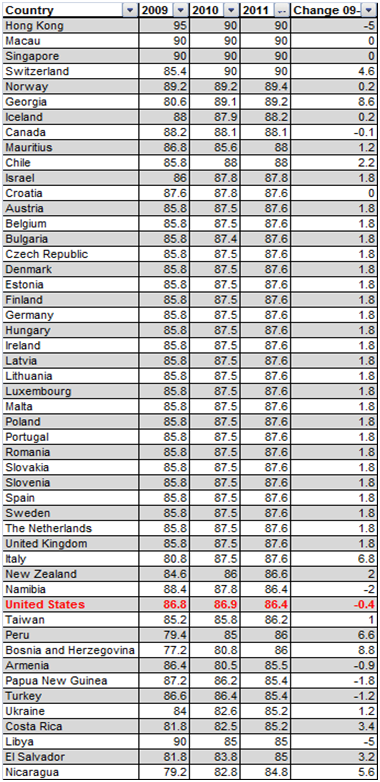
As you can see from this chart (made by me with Heritage's data), the trade policies of only three countries ahead of (or tied with) the United States regressed between 2009 and 2011. As already mentioned, the US also regressed, while every one else liberalized (and reaped the benefits therefrom).
Of course, anyone paying attention to US trade policy over the last two years already knew this from the mounds of anecdotal evidence presented on this blog and other (more reputable) outlets. As I grumbled a few weeks ago:
Obama has placated his anti-trade base (and their congressional muscle) on Buy American, Mexican Trucks, Chinese Chicken Imports, Section 421 (tires), Section 301 (Chinese "green" subsidies), changes to US trade remedies laws,carbon tariffs - the list literally goes on and on. He shelved his early 2009 support for the Colombia and Panama FTAs (and KORUS until last June) at the first whiff of congressional stink. He has embraced mercantilism and adopted a "trade policy" in the NEI that is as unoffensive as it is ineffectual.Meanwhile, the rest of the world has pursued bilateral and regional free trade agreements at a breakneck pace. Thus, it's no surprise that the new Heritage data show the United States stagnating on trade while the rest of the world surges ahead. Indeed, it'd be a shock if the numbers showed anything else.
A lot of pundits and prognosticators are optimistic that this upsetting trend will change course in 2011, and that the Obama administration will finally engage on free trade and help the United States live up to its reputation as the world's free trade leader. Recent talk from the administration on KORUS, zeroing and Mexican trucks appears to confirm this conventional wisdom, but it's only a start. A real change of course on US trade policy will require real action to back up the White House's nice words, as well as new trade liberalization policies to catch us up with the rest of the world.
I sure hope that the conventional wisdom on US trade policy in 2011 turns out to be correct because if things don't change soon, we'll all be pining for the good ol' days when the United States sat pretty in 38th place.