Showing posts with label Basic Economics. Show all posts

Thursday, September 5, 2013

I, Coffee

The miracles of capitalism and global supply chains never cease to amaze (at p. 142):
For instance, even the relatively simple GVC [global value chain] of Starbuck's (United States), based on one service (the sale of coffee), requires the management of a value chain that spans all continents; directly employs 150,000 people; sources coffee from thousands of traders, agents and contract farmers across the developing world; manufactures coffee in over 30 plants, mostly in alliance with partner firms, usually close to final market; distributes the coffee to retail outlets through over 50 major central and regional warehouses and distribution centres; and operates some 17,000 retail stores in over 50 countries across the globe. This GVC has to be efficient and profitable, while following strict product/service standards for quality. It is supported by a large array of services, including those connected to supply chain management and human resources management/development, both within the firm itself and in relation to suppliers and other partners. The trade flows involved are immense, including the movement of agricultural goods, manufactured produce, and technical and managerial services.
Maybe that's why a steaming cup of flavored water costs two bucks? (And even more in China.)

h/t David Henderson.

Thursday, August 8, 2013

TV News Revelation: Imports Are Good (VIDEO)

This CNBC piece is unquestionably great, and they deserve major props for running it.  But my favorite part is, without question, the concluding "wow" from the anchor who works for a business news network yet acts as if the idea that imports are actually good for the US economy - a fundamental tenet of market economics that has decades of empirical support - is some sort of grand revelation.


Wow, indeed.

Of course, given the hackish trade stuff that pervades the mainstream media (*cough*ABC*cough*), perhaps the CNBC anchor here can be forgiven for being surprised by basic trade economics.

Hopefully, more pieces like this will occur and cause people of all stripes to finally understand just how dumb (and immoral) mercantilism and protectionism are.

But I'm not holding my breath.

Wednesday, August 7, 2013

Subsidized Stupidity

Now that America's sugar program is - like many other costly forms of corporate welfare in this time of strained federal budgets - facing increased scrutiny, the subsidy-loving folks at Big Sugar have devised a new plan to keep all of their sweet, sweet taxpayer cash flowing:
Just days before the U.S. House of Representatives voted down the latest effort to gut U.S. sugar policy, Congressman Ted Yoho (R-FL) introduced a new “zero-for-zero” sugar policy that instructs the administration to target the foreign sugar subsidies that are distorting world prices and keeping a free market from forming.

The American Sugar Alliance (ASA) praised Yoho and the nine original co-sponsors of H.Con.Res. 39, which would also advocate for the end of U.S. sugar policy once market-distorting programs in foreign countries are eliminated.... 
Co-sponsors of the zero-for-zero policy include Reps. William Cassidy (R-LA), Lois Frankel (D-FL), Alcee Hastings (D-FL), Doug LaMalfa (R-CA), Trey Radel (R-FL), Martha Roby (R-AL), Tom Rooney (R-FL), Kurt Schrader (D-OR), and Frederica Wilson (D-FL). Weston says the industry is encouraging others to cosponsor.

In addition to the ASA, free-market advocates like the American Conservative Union have publicly endorsed the Yoho legislation.
As I explained in my big Cato paper on global subsidy reform, ideas like these are, despite their uniform awfulness, par for the course from subsidy recipients and their congressional benefactors:
Politicians and rent-seeking interest groups often claim that subsidies are essential to  offset the unfair advantages bestowed on subsidized foreign competition. This illogic is pervasive among protectionists in Congress, such as Sen. Sherrod Brown (D-OH), who routinely call for new U.S. protectionism in response to China’s “improperly subsidizing manufacturing industries,” but such thinking can infect even the most fiscally conservative members. For example, tea party icon Sen. Marco Rubio (R-FL), who represents sugar-producing Florida, recently justified his vote to protect the U.S. sugar program on the grounds that it is necessary to counteract foreign subsidies. That sort of logic is what propels the spiral of tit-for-tat subsidization.
Thus, it's wholly unsurprising to see Rep. Yoho and his sugarland colleagues support the zero-for-zero idea.  However, I must say that I'm a little shocked that supposedly "conservative" non-profit organizations - folks who don't represent Floridian sugar farmers and are supposedly guided by the principles of limited government and fiscal conservatism - have signed on to Big Sugar's latest scheme.  (According to Rep. Yoho's "Dear colleague" letter urging support for this plan, the following groups are big fans of the zero-for-zero legislation: ACU, Americans for Job Security, lessgovernment.org, 60 Plus Association, Citizen Outreach, Institute for Liberty, Let Freedom Ring, Frontiers of Freedom, Institute for Policy Innovation, Americans for Limited Government.)  Indeed, as I've frequently discussed (see, e.g., above), there is absolutely nothing conservative, libertarian or "free market" about implementing or maintaining subsidies, even where other countries are dumb enough to implement/maintain their own.  And Big Sugar's "zero-for-zero" scheme in particular fails from an economic, legal and logical perspective:

  • Cato's Sallie James hits on most of the economics: "The question is: what should the United States do while we are waiting for this nirvana to materialise, a process that would be very lengthy indeed? I would suggest that doing ourselves a favour and abandoning the terrible U.S. sugar policy—costing the economy billions of dollars a year through artificially high sugar prices and, now, government sugar purchases—is a good start. Let other countries distort their markets and subsidise sugar importers’ consumption, as is their wont. We don’t have to follow them, and American consumers and businesses would benefit from a freer domestic market in sugar."  I'd just add the fact that, as I recently noted, America's sugar program imposes a regressive tax (at one point almost 50%) on American families who are forced by the US government to pay higher prices in order to line Big Sugar's pockets.  And it's immoral protectionism like this that keeps US food prices high and rising.
  • On the legal front, the zero-for-zero idea, just like all other forms of this trite "unilateral subsidy disarmament" argument, completely ignores the fact that there are national "countervailing duty" laws and multilateral (WTO) anti-subsidy rules that protect domestic industries from the unfair, injurious subsidization of their competitors by foreign governments.  So if, as Big Sugar claims, the Brazilian government is using billions of dollars worth of predatory subsidies to try to kill the US sugar industry, Big Sugar or its workers can lawfully seek protectionist duties against subsidized Brazilian sugar imports, or they can lobby the US government to bring a WTO dispute against Brazil.  And, of course, if we eliminated our dumb subsidies, we'd be on much stronger, more principled ground to bring such cases.  So the idea that rampant, unilateral sugar subsidies and protectionism are necessary to protect Big Sugar from evil Brazilian (or other countries') sugar exports is absolutely false.
  • Finally, it is simply mind-boggling that "free market" groups fail to grasp the horrible illogic and completely un-conservative implications of Big Sugar's zero-for-zero policy: it argues against the elimination of almost every form of corporate welfare provided by the US government.  For example, China is a global leader in solar panels production and trade, and Beijing undoubtedly provides billions of dollars worth of subsidies to Chinese solar manufacturers.  So does that mean that the ACU and those other "conservative" groups will support Solyndra and the rest of the Obama administration's solar subsidies until China agrees to stop subsidizing its solar panel producers?  The same could be asked of American wind power and other "green" subsidies, steel subsidies, ethanol subsidies, automobile subsidies (hooray bailouts!) and on and on and on.  As I noted in my Cato paper last year, almost all governments (unfortunately) are guilty of throwing billions of taxpayer dollars at their industries of choice. So should the US government therefore keep all of our immoral, inefficient and distortive corporate subsidies - $98 billion in 2012 alone! - until all foreign governments around the world wise up and terminate theirs (i.e., never)?  No. Of course not.
So, really, what's going on here?  Why on earth are these "conservative" groups siding with Big Sugar and against US taxpayers (and basic economics and reason)?  Well, I can see only two options, neither of which is very flattering: either they're wholly ignorant of the economics and law of global subsidies, or... well... I'll let you draw your own conclusions about option #2.

Sunday, June 2, 2013

The Folly of Bilateral Protectionism, China Solar Panels Edition

As you may recall, after a string of very public bankruptcies (*cough* Solyndra *cough*), US solar panel producers - and the Obama administration folks who happily subsidized them - were quick to blame China.  If only the Chinese cheaters were purged from the US market, they argued, America would become a global solar panel powerhouse, and the green jobs would flow like (highly subsidized) milk and honey.  To achieve this purge, the "domestic" industry (led by Germany's SolarWorld) petitioned the US government for steep anti-dumping and anti-subsidy (countervailing) duties on Chinese imports, and the administration - using US laws that tilt greatly in favor of domestic protectionism - was quite willing to oblige.

However, a new story from the Financial Times' Ed Crooks shows just how wrong-headed that move has turned out to be, and provides yet another lesson in basic trade economics.  Prices for panels have risen (slightly), but American producers and workers haven't benefited in the least.  Instead (and as I repeatedly predicted), jobs and output are down here, and other imports - not US panels - have replaced the Chinese ones that have been effectively banned from the US market.

Behold, the folly of bilateral protectionism - and the reality of trade diversion - in all of their glory:
In one respect, the duties do seem to have been effective. US imports of cells from China have dwindled, from an average of 11m per quarter in 2011 to just 900,000 in the first quarter of 2013. 
The pay-off in US manufacturing and jobs, however, has been elusive. The US has capacity to produce about 1,845 megawatts of solar panels per year, according to IHS, a research company. That is down from 2,027MW a year ago. 
The Solar Foundation, an industry-backed think-tank, found that solar companies lost about 8,200 manufacturing jobs last year, about 22 per cent of their total, and expected to regain only about 2,600 this year. 
SolarWorld itself has continued to cut jobs in Oregon.... 
Robert Petrina of Yingli Green Energy, the Chinese group that was the world’s largest solar panel manufacturer last year, said it was untrue that the duties have had no effect, citing higher cell prices in the US than in some other markets such as South Africa, as evidence of the distortions they were causing.... 
Yingli has been sourcing cells from Taiwan to avoid being caught by the duties on Chinese products. It had its second-best quarter on record in the US in the three months to March and is on track to double its sales to US utilities this year. 
Another source of supply to the US has been a surge in imports from Malaysia. The US imported almost as many Malaysian solar cells in the first three months of this year, as in the whole of 2011. 
Analysts said much of the increase was probably caused by First Solar, an Arizona company that was the world’s second-largest manufacturer of solar panels last year. It has 85 per cent of its production capacity in Malaysia, and is building several large solar plants in the US....
As I mentioned when the original decision to impose duties on Chinese solar panels, part of the reason for the trade diversion at issue here is because the Chinese producers achieved a small victory during the investigation, omitting solar panels made in third countries (like Taiwan) from Chinese parts.  This allowed a few Chinese companies to lawfully circumvent the AD/CVD order and still ship large quantities of their product to the United States.  That said, the surge of Malaysian and other imports make clear that even closing this "loophole" would do nothing to help US producers and workers for one simple reason: other countries' producers are still cheaper than their American counterparts.

Yet another reminder that protectionism doesn't work, and all those US subsidies were a horrible waste of taxpayer dollars, regardless of those dastardly Chinese cheaters.

Monday, March 4, 2013

China's "Ghost Cities" Go Mainstream, But Will Anyone Actually Notice?

From Business Insider comes news that 60 Minutes has done an in-depth profile of China's ghost cities - only a couple years after many of us started noticing this creepy and telling phenomenon, but, hey, better late than never.  BI has plenty of good screenshots worth perusing, but here's the whole video for your viewing pleasure:


After seeing this crazy video (or any of the others that have been floating around since 2009), how can anyone steadfastly declare the inevitability of China's future economic dominance or take headlines like the following seriously?
(Hint: they can't.)

Wednesday, February 27, 2013

Speaking of Distortions...

In my new Cato paper, I discuss the distortions and economic loss caused by current US export restrictions on natural gas and crude oil - one of the big reasons why fundamental reform of our export licensing systems is desperately needed.  Most of the current policy debate has focused on the natural gas market, but the economic distortions are just as prevalent for crude oil.  Case in point: this new Bloomberg article (emphasis mine):
A glut of shale oil in fields from Texas to North Dakota is forcing producers to find ways around the U.S.’s three-decade-old ban on crude exports in order to seek higher prices in foreign markets.

Kinder Morgan Energy Partners LP (KMP) is among companies setting up mini-refineries to process certain grades of crude just enough to qualify them as refined fuels, which are legal to export.

The industry’s best hope is ultra-light oil, which is so abundant in shale rock that it has flooded the Gulf Coast and traded for a record discount to global benchmark Brent crude last quarter. Potential revenue for exports is $40 billion a year based on global prices, or about $9.7 billion more than what the same oil fetches in the U.S....

Because there are not enough buyers where it’s pumped, the easy-to-refine crude has become the vanguard of an effort by the oil industry to get Congress to further weaken U.S. limits on most crude oil and natural gas exports that have been in place since the early 20th century....

Valero Energy Corp. (VLO), Kinder Morgan and Marathon Petroleum Corp. (MPC) are spending $850 million to build mini-refineries or upgrade existing plants to process the ultra-light crude. The soonest to come online is Kinder’s, set for the first quarter of 2014.

The plants will do little more than heat oil and condensate to a boiling point and distill them into separate fluids. Prices for condensate average about $4.57 less per barrel than heavier U.S. crude, crimping producer profits by as much as $1.7 billion a year, according to calculations based on RBN Energy data....

The units, called splitters, may be able to process as much as 300,000 barrels of crude a day, Luaces said. The mini- refineries being built “split” the condensate into naphtha, a feedstock for making plastic and other chemicals, and kerosene, which can be exported to markets in Asia and Latin America, he said.

Those chemically simpler products may not fetch as much as finished gasoline or diesel fuel, but the lower cost of running the splitter makes it attractive to sell them on international markets, said Judith Dwarkin, chief economist at ITG Investment Research Inc. in Calgary.

“It’s a cheap way around the export limitation,” Dwarkin said in an interview.

There are no limits on refined products. U.S. fuel exports reached an all-time high last year of an average 2.6 million barrels a day, according to Energy Department data. U.S. fuel imports from OPEC have fallen 37 percent, and the country’s petroleum deficit, the difference between the cost of its hydrocarbon imports and exports, fell to $18.7 billion, the lowest since 2004, according to data compiled by Bloomberg.

“Some molecules are painted with a no export sign,” said Braziel, of RBN. “Other molecules are painted with the OK to export sign, and there doesn’t seem to be any rhyme or reason as to why some molecules are OK and some aren’t.”
So because of US crude oil export restrictions, domestic oil producers are spending billions of dollars to construct mini-refineries that produce a slightly-refined product that may be freely exported but sells at a discount to crude on the international market.  Meanwhile, simply getting the US government out of the way and permitting unlimited crude oil exports would generate $40 billion per year for US energy producers and their workers.

That seems... inefficient.

So isn't it time we established some rhyme and reason to the system?

Wednesday, November 14, 2012

Global Competitiveness, Ctd.

Two very timely updates since last night's post on US corporate taxes and global competitiveness:
  • Cause. First, the National Federation of Independent Business, the main trade association for small businesses in the United States, highlights other aspects of the Ernst and Young study that I mentioned last night: "New data released today by Ernst and Young shows tax increases shows that allowing the top two tax rates to increase, as has been proposed by President Obama and many Members of Congress, would greatly impact small businesses. The preliminary results of the study show business owners paying the top two rates account for: 72 percent of all S corporation income; 61 percent of all partnership income; and 13 percent of all sole proprietorship income. Subchapter S corporations, partnerships, LLCs, and sole proprietorships are all considered "pass-through' businesses for tax purposes, in which business income is taxed at the individual rates. NFIB research shows three-quarters of small businesses are organized in such a manner. In addition to this week's Ernst and Young data, the Congressional Joint Committee on Taxation recently published research that estimates around 53 percent of business income would be impacted allowing tax relief to expire on the top two individual brackets, impacting an estimated 940,000 who earn business income.  

  • Effect.  Second, we see the real world effects of the US government's inability to reform its painful, arcane tax and regulatory policies: "Cisco CEO John Chambers says there’s one place in the world where doing business is easy – and it’s not the U.S.  Canada, he told analysts during a Tuesday conference call, is “the easiest place to do business." "It doesn’t matter which party is in power, even in their provinces, i.e. their states... leaders in Ottawa get it,” he said. “They drive down through and make it very easy to do business there. You’re going to see us grow our business there as well as invest overall."   In case you've forgotten, Canada has repeatedly lowered its corporate tax rate over the last several years, and it now stands at 15% - a full 20 percentage points lower than the federal statutory corporate tax rate in the United States.  Oof.

Friday, October 26, 2012

VIDEO: An Outsourcing Explanation So Simple Even a Politician Can Understand It

A brand new, and much-needed, video from the Cato Institute dispels the widely-held myths about outsourcing and protectionism.  Enjoy, then share:


Tuesday, August 28, 2012

Sure, You Can't Afford Food, But At Least You're Buying Local

From the New York Times travel blog comes a humorous - and totally unintentional - economics lesson in a routine story about traveling in Scandinavia on a budget:
WHY IS NORWAY SO EXPENSIVE?

Most people assume Norway costs so much because of its high tax rates. Not so, said Nils Henrik von der Fehr, chairman of the economics department at the University of Oslo. Taxes play a supporting role — there is a 25 percent value-added tax on most products, for example — but the real reasons are labor costs and agricultural protectionism.

“The most important factor is the way our labor market works: centralized bargaining,” Mr. von der Fehr said. “One has made an effort to have an egalitarian wage structure. While people like me are not well paid compared to our colleagues in other countries, people at the lower end earn much more. You don’t have cheap labor in Norway.

“All the things you want as a tourist — hotels, restaurants — are labor-intensive,” he said. “That’s why it’s nice for us to be a tourist in the U.S.: everything you want is cheap because of the abundance of cheap labor.”

Another factor is the high tariffs on agricultural imports that keep Norwegian farms in business: “We have perhaps the most protected agricultural system in the world,” he said. “It’s not a particularly easy place to grow anything. Farms are small and the season is short.”

That may mean higher food prices, but at least you are buying local.
The NYT earlier notes that a cup of coffee will cost you $4.50 in Oslo, a fast food burger and fries is a whopping 23 bucks, and - most depressing - a six-pack of "mediocre beer" goes for a buzz-killing $30!  When asked how they cope with these prices, a Norwegian pharmacist quips "It's easy. We buy everything in Sweden."

Smart dude, but I'm not so sure that's the result of a sound economic policy.

Now, I freely admit that I don't know anything about Norway's labor regulations, but the bit about agricultural tariffs finds strong anecdotal support in last December's blog post on how Norway's import-prohibitive dairy protectionism caused butter prices to spike to an insane $450 per pound, thereby threatening a "cookie-less Christmas" in the world's butter cookie capital.  And if economist Mr. von der Fehr is correct about Norway's labor regulations, you just have to love how an obsession with income inequality has - combined with fierce protectionism - created shared misery in its attempt to prevent unequal prosperity.

But, hey, at least you're buying local!

(Or rich enough to afford traveling to Sweden and smuggling back some reasonably-priced cookies.)

Wednesday, August 15, 2012

Why Free Traders (and Policy Fans) of All Political Stripes Should Root for Paul Ryan

A few days ago, I examined Republican Vice Presidential candidate Paul Ryan's congressional votes on subsidies and international trade, and concluded that he had a pretty good, but not great, record.  But that unfortunate fact doesn't mean that I'm not rooting for the guy - I definitely am, and if you support better US trade policies or simply wish for political campaigns to focus more on real policy issues rather than stupid trivia, then you should too.

Regardless of your political affiliation.

In today's Wall Street Journal, the Hoover Institute's Robert Barro begins to explain what I mean by the bold statement above.  He first notes that "The level of economic commentary during the presidential campaign has not been high" - a disturbing fact that I've repeatedly lamented here.  Then, after quickly explaining the basic - and almost universally-accepted - economic truths about the overwhelming benefits of free trade (including outsourcing) and the undeniable harms of "socialistic" business subsidies, Barro discusses why Mitt Romney's selection of Ryan - most definitely not a vocal free trade zealot - matters for these issues:
With the addition of conservative thinker and budget expert Rep. Paul Ryan to the Republican presidential ticket, we can hope that the economic dialogue will become more serious. And perhaps this added substance will extend beyond the important issue of long-term fiscal reform to encompass the enduring but still crucial debate about socialism versus capitalism.
The post-Ryan political conversation thus far appears to be fulfilling Barro's hopes.  For example, earlier this week, the WSJ reported that Ryan's selection has set off a debate about the proper scope of government:
Amid growing complaints about the pettiness of American politics, the 2012 presidential campaign is turning into a far-reaching, big-picture debate over the size and scope of government.

Mitt Romney's choice of Rep. Paul Ryan of Wisconsin, an uncommonly assertive spokesman for free markets and small government, to be his running mate on the Republican ticket has highlighted the differences between them and President Barack Obama...

Until now, in a 2012 campaign bristling with negative attacks and accusations about the character of the two candidates, big policy choices have been eclipsed.

That changes with the selection of Mr. Ryan, author of detailed conservative budget plans that call for major changes to many social programs, offering voters a choice: Are welfare services a safety net, or can they breed dependency? Is Medicare a social contract with the elderly, or unsustainable and in need of repair? And will cuts in government spending hurt economic growth, or foster a more robust private sector?
Myriad stories along the same lines have emerged over the last few days, and it seems that almost everyone with a Twitter or Facebook account has seen or posted something about the Ryan plan, the budget, Medicare cuts or some other serious policy issue.  Contrast this with the last several months of soul-crushing, superficial "debates" about tax returns, Olympic uniforms, who ran Bain Capital and when, fast food chicken, dogs (on car roofs or dinner plates), and... well, you get the idea.  The level of election-related discourse has undeniably improved in the last week.

Now, I have no idea whether this improvement will last through November.  I actually think it will because both sides seem to think that the other's fiscal position is political kryptonite, but, frankly, it's not just the public budget and economics debate that has me rooting for Paul Ryan - it's what a Romney/Ryan victory would mean for the longstanding behind-the-scenes fight between policy advisers and political hacks, especially during campaign season.  As I've repeatedly mentioned here in the context of trade, that fight - one that I've unfortunately experienced firsthand - tends to go something like this:
Adviser: There is ample historical and empirical evidence showing that policy [X] is the superior  position from an economic and moral perspective.
Hack (briefly looking up from his blackberry): Umm, yeah, that's great, dude, but policy [X] polls poorly, and we're just not gonna take the risk in an important election year. On the other hand, the public just loves policy [Y], so we're gonna stick with that, even though we all know it's an inferior position.  Now if you'll excuse me, I gotta jet - need to meet [politician] at Morton's for a fundraiser.
Adviser (mumbling under his breath): I hope you get hit by a taxi.
I The adviser may or may not have said that last thing, but you couldn't really blame him if he did.  This debate plays out over and over in political offices and on related conference calls across the country: principled wonks want a political debate about important policy issues, but political consultants, armed with polls and focus group testing, are scared to death of "real" debates' repercussions and thus seek to avoid them like the plague.  So we're stuck with month-long political fights about whether Harry Reid's friend's cousin's dogsitter saw Mitt Romney's 1997 1040EZ - fights that, by displacing real policy discussions, prevent better public understanding of important issues and thus doom the political discourse to repeat its vicious cycle of vapidity over the next election cycle.

As a result, real policy solutions rarely, if ever, materialize.

This is precisely what's caused our dismal political discourse about international trade, and US trade policy has therefore suffered.  The debate over entitlement reform has faced a similar fate: the debts have mounted as the political can has been kicked down the road, and both parties' political cowardice is to blame.  With the Ryan pick, however, it appears that we'll finally have a substantive debate about the need for serious entitlement reform - an issue that, also like free trade, is politically risky but supported by ample economic evidence (see Barro's op-ed for a refresher course, if needed).  And while it's totally unclear whether a Romney/Ryan victory will actually ensure real entitlement reform, what seems clear is that it should have a serious impact on the future of America's political discourse.  If they win, the wonks finally have proof that forcing a real debate about real policy in the face of uncertain public opinion is not a political deathblow.  In short, it shows that the American people can, given the right message and the right facts, overcome their ignorance, sift through the demagoguery and vote for good policy instead of good hair.

If Romney/Ryan lose, however, the policy advisers - and the political discourse more broadly - are in pretty deep trouble for the foreseeable future.  In the aforementioned internal debate, the hacks will have not only those risky poll numbers, but also the following conversation-ending addendum:
"And you do remember what happened with Romney and that Ryan guy, right?  Yeah, that's what I thought."
And at that point, I will pack up my briefcase and move to the countryside, forever unable to turn on the TV for fear of watching yet another bipartisan assault on outsourcing or Medicare reform or whatever.  (Shudder to think.)

So I root for Paul Ryan.  He might not be the best free trader; he might not be my "perfect candidate"; and his victory might not even ensure a conservative solution to our real entitlement crisis.  But if he loses, lord help us, the hacks will have won, and our political discourse will get even worse.

And our TV-watching won't be the only thing to suffer.

Wednesday, August 8, 2012

Umm, Yeah, About Those Amazing Chinese Solar Subsidies...

Over the last several years, China's subsidization of its domestic solar panel industry has attracted ire and envy in the United States.  Bankrupt US solar producers and the US politicians who subsidized them have been quick to deride pernicious Chinese subsidies - rather than their own corporate or policy mismanagement - as unfairly creating a global export juggernaut that has doomed their business.  I've already discussed the US Department of Energy's 2011 "blame China" parade following Solyndra's collapse, and it appears that Abound Solar and its political champions are following suit:
Abound Solar filed for bankruptcy earlier this month, succumbing to intense competition from China that has sharply driven down the cost of solar panels, said Thomas Tiller, who served as Abound's chairman.

Tiller said the Chinese government provided about $35 billion in subsidies to Chinese solar companies, resulting in sharp growth in production capacity that outpaced demand and pushed down the price for panels by more than 50 percent in just a year.

"Such a severe market change made it difficult for Abound and others to survive," he said in remarks prepared for a House of Representatives oversight committee hearing.

Prior to filing for bankruptcy, Abound received about $70 million of a $400 million loan guaranteed by the U.S. Energy Department.

The drop in the solar panel price was bigger than the Energy Department and other experts expected at the time the Abound loan was finalized, David Frantz, acting executive director of the department's loan program, said in prepared testimony.
Meanwhile, American industrial policy fetishists have been quick to note the dominance of the Chinese solar industry as proof that the US should have mirrored China and thrown even more taxpayer money at our solar panel producers.  For example, here's FP's Clyde Prestowitz throwing out a blatant I-told-you-so back in March of this year:
The solar panel industry was identified by the Chinese government long ago as a target of special attention. Indeed, I recall being in a White House meeting in 2009 to discuss the prospects for the U.S. solar panel industry. I told the administration's top economists then that unless they were prepared to match the enormous incentives China was planning to provide to its industry ,the U.S. industry would be blown out of the water. They weren't prepared to match and the industry is, in fact, now being blown out of the water. Anyone who had had the experience with Japan or who had an ounce of understanding of how strategic industry targeting and export-led growth works could have foreseen exactly what has come to pass as China has poured about $34 billion of subsidies into its industry which exports about 95 percent of its production. That would be the loss of several thousand U.S. jobs and the bankruptcy so far of 12 U.S. companies. This is not to mention the inevitable reductions in R&D spending and innovation in the face of the tsunami of imports from China.
Prestowitz, much like the US Steelworkwers union, appears to think that the billions in subsidies that the US government has thrown as American solar producers are woefully insufficient, and that just a few billion more would have all but guaranteed a globally-dominant US industry that's just brimming with profitability... you know, just like the, err, Chinese industry:
China’s top ten photovoltaic makers have accumulated a combined debt of 17.5 billion U.S. dollars so far, leading the whole industry to the brink of bankruptcy, data from U.S. investment agency Maxim Group showed.

LDK Solar, the world’s second-largest maker of solar wafers, and Suntech Power, the world’s largest solar panels producer, are the mostly likely to be headed for bankruptcy, Maxim noted....

Based on preliminary results of domestically traded photovoltaic companies for the first half, nearly 80 percent have slashed their earning forecasts while the top ten brands, listed overseas, posted a loss of 612 million U.S. dollars in the first three months this year.

Yingli Green Energy Holding Co., another leading solar power company in China, said over the weekend that the company cut its delivery growth forecast of photovoltaic modules from 15 percent to 13-14 percent for the second quarter, and gross margin from previous 4.5-4.9 percent to around 4.5 percent for the period.

“A gross margin of 4.5 percent indicates a loss, for sure, in the second quarter,” said Meng Xiangan, vice chairman of the Chinese Renewable Energy Institute. According to Meng, gross margins for China’s ten leading photovoltaic makers were all below 10 percent in the first quarter, led by Canadian Solar, who earned a gross margin of 7.7 percent but still reported a loss of around 20 million U.S. dollars. What’s worse, cash flows in Chinese solar makers are even tighter as many have rolled their debts over to 120 to 180 days, according to investment firm Helix Investment Management.
Gee, so what happened?  How could the subsidized Chinese juggernaut now be on the brink of disaster?  If only someone could have predicted this.  Oh, wait:
As tensions heighten over questionable subsidies and anti-dumping cases against China’s solar panel manufacturing sector, most non-Chinese citizens are quick to claim that China is robbing the industry from other countries. Indeed, China’s doubling of solar panel exports in 2009 and 2010 was followed by a string of bankruptcies of solar firms in other countries, including Germany and the US, in 2011. However, despite China’s huge gains in its global market share, its solar sector now likely faces a serious consequence of its explosive growth: overcapacity. Manufacturing capacity of solar panels is outpacing global demand, and as a result the prices of solar products have plunged; and now many Chinese solar manufacturers “face ‘suicidal’ prices on excess output” and are slashing prices in order to liquidate inventory.
So, it appears that all those Chinese (and American and European and...) subsidies have led to massive overproduction and a collapse in solar prices, and Chinese solar companies (and their global counterparts) simply can't stay afloat in the current market.  Of course, the current US antidumping and countervailing duty investigations of Chinese solar panel imports certainly aren't helping the Chinese industry's bottom line, but those cases very likely wouldn't have happened without all that sweet, sweet government cash to depress prices and make the industry vulnerable to anti-subsidy allegations.

Thus, the very subsidies that were designed to ensure Chinese solar industry dominance have helped cement its near-term demise (and brew up a couple trade disputes in the process).  Yes, the Chinese government might swoop in and "save" its ailing solar industry - it certainly has enough spare cash lying around to do so - but that salvation would come at a clearly huge expense.  The debt-ridden US government has no such "luxury," but considering the past few years of subsidized failures like Solyndra, Abound Solar and the rest, coupled with the experience of the super-subsidized Chinese solar failures, one must really wonder if maybe - just maybe - we're better off for it.

Tuesday, July 31, 2012

Have US Incomes Really Stagnated Since the 1980s? (Hint: No)

One of the most common justifications for protectionism, tax increases, government spending or intrusive economic regulation is the "fact" that median incomes in the United States have depressingly stagnated since the 1980s. For example, President Obama in his December 2011 speech in Osawatomie, Kansas stated:
We simply cannot return to this brand of “you’re on your own” economics if we’re serious about rebuilding the middle class in this country. We know that it doesn’t result in a strong economy. It results in an economy that invests too little in its people and in its future. We know it doesn’t result in a prosperity that trickles down. It results in a prosperity that’s enjoyed by fewer and fewer of our citizens.

Look at the statistics. In the last few decades, the average income of the top 1 percent has gone up by more than 250 percent to $1.2 million per year. I’m not talking about millionaires, people who have a million dollars. I’m saying people who make a million dollars every single year. For the top one hundredth of 1 percent, the average income is now $27 million per year. The typical CEO who used to earn about 30 times more than his or her worker now earns 110 times more. And yet, over the last decade the incomes of most Americans have actually fallen by about 6 percent.
President Obama then used his scary median income statistic - and a few others - to justify his calls for all sorts of taxes and Big Government stuff (aka "fairness" and "investments").  And he certainly isn't alone.

Fiscal conservatives typically counter these median income data by noting that the base numbers don't include government transfers and benefits, and these critics definitely have a point.  But Steve Landsburg has an even simpler rebuttal: the overall median income number is a total "racket":
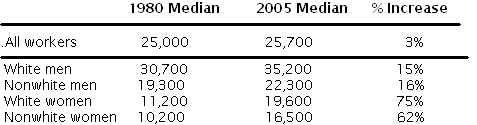
If you’re the sort of person who reads economics blogs, you’ve probably heard that the median US worker has enjoyed hardly any income gain over the past few decades. Here are the numbers behind the noise (all corrected for inflation): 

A mere 3% increase over 25 years does indeed look pretty grim. And note that the year 2005 is pre-crash, so what we’re seeing is not an artifact of the recession.

Now let’s look a little deeper and ask which demographic groups account for all this stagnation. White men? Nope, their median income is up 15%. Nonwhite men? Up 16%. White women? Up 75%. Non-white women? Up 62%. That’s everybody:

If you're like me and have never seen this breakdown before, your mouth is currently agape with surprise.  Landsburg then explains why median income shoots up in every demographic sector while the overall median remains nearly unchanged (emphasis mine):
Imagine a farmer with a few 100-pound goats and a bunch of 1000-pound cows. His median animal weighs 1000 pounds. A few years later, he’s acquired a whole lot more goats, all of which have grown to 200 pounds, while his cows have all grown to 2000. Now his median animal weighs 200 pounds.

A very silly person could point out to this farmer that his median animal seems to be a lot scrawnier these days. The farmer might well reply that both his goats and his cows seem to be doing just fine, at least relative to where they were.

That’s exactly what’s happened with median incomes. Each demographic group has progressed, but at the same time, there’s been a great influx of lower income groups — women and nonwhites — into the workforce. This creates the illusion that nobody’s progressing when in fact everybody’s progressing.
After correcting for this very significant demographic change and assuming that 1980's workforce was identical to today's workforce, Landsburg finds that "the overall median income in 1980 would have been $19,600. Today’s $25,700 represents a 31% increase over that corrected figure."

Landsburg noted that he took these numbers from Edward Conard’s new book Unintended Consequences: Why Everything You've Been Told About the Economy Is Wrong.  Another interesting tidbit from that book (along with the aforementioned one about benefits): "The table, because it only shows medians, does not show the explosion in income growth above the median. Fully half of the new jobs created since 1980 have been high-paying professional jobs; prior to 1980, only 23% of jobs were in that category."

That is very important and, again, something that President Obama and his friends conveniently fail to mention.  Landsburg also adds a point of this own: "the table fails to account for the vast increases in leisure time over the past 40 years and the equally vast increases in the quality of the goods we buy. Those things matter too."

Indeed, they do.

Monday, July 16, 2012

More on the Idiocy of Our Current Political Discourse re Trade

Last night, I promised that I wouldn't get into the weeds explaining the blatant economic ignorance currently displayed by our political leaders on the issues of trade and outsourcing.  I'm glad I avoided that aspect because today's Wall Street Journal contains a fantastic recap of many of these economic facts.  Not much of this information will be new to readers of this blog, but it is, in my view, the best and most concise summary of many of the economic reasons why free trade, and imports in particular, is undeniably good for the US economy.  After setting the stage with a quick summary of the political firestorm surrounding those made-in-China US Olympic uniform, the WSJ lays out why politicians' anti-import/trade posturing defies all economic sense:
[I]mports of all kinds drive American jobs and export competitiveness. Most goods imported by the U.S. are used to make other goods. The Washington-based Trade Partnership, which studies such things, says that 62% of the $2.2 trillion of imports in 2011 were inputs for producers.

These include oil, precious metals, minerals, green coffee and lumber. But the list also includes motor vehicle parts, semiconductors, aircraft engines and parts, steel products, fertilizers, plastics and machinery and other equipment. American companies buy these products, make other things with them or add value and then sell their output at home and abroad. If they can't buy these imports at good prices, U.S. producers can't compete globally.

Protectionists portray imports as coming from Third World sweat shops that undercut American labor. But half of U.S. imports come from such developed countries as Canada, Japan and Germany. In 2011 imports from low-income countries amounted to less than 1% of the U.S. total.

Even finished goods imported by the U.S. often have a U.S. export component. Today's manufacturers, no matter where they are located, use an international supply chain that employs Americans. U.S. research, development and design—high-paying jobs—are behind much of what is made overseas.

And what about those Ralph Lauren-designed berets? Well, the American Apparel and Footwear Association says that while their industries are now dominated by imports, these two markets in the U.S. employ more than four million people in everything from design to marketing, merchandising and retail. The International Trade Commission says more than half of the value of imported apparel sold in the U.S. is American. The Commerce Department says that more than 50% of direct importing operations in the U.S. are small businesses.

Imports also raise U.S. living standards. According to Cato Institute trade analyst Dan Ikenson, prices of many tradeable goods like electronics, toys, furniture and apparel in the U.S. have been dropping over the last decade even as the price of nontradeables like health care and education have increased sharply.

President Obama says he wants to double U.S. exports from 2009 to 2014, which makes sense even if the government will have little to do with it. As the U.S. Chamber of Commerce points out, 80% of the world's purchasing power is outside the U.S. along with 95% of consumers.

But this export boom won't happen if the U.S. doesn't keep its own markets open. Protectionism will impoverish our best customers. And there is a risk that trading partners will retaliate with their own new trade barriers. Both would be devastating for U.S. producers: Fast-growing middle-income countries like Mexico and China are also the fastest growing export markets for the U.S.
Understanding these facts, as well as the undeniable moral depravity of politicians' anti-trade and anti-outsourcing demagoguery (something known since the time of Adam Smith), I again ask:
Why on earth is the Republican party indulging such garbage (see, e.g., this most recent, depressing example) instead of attacking it?
Seriously.

Sunday, February 19, 2012

"Chinese Labor, Cheap No More" (UPDATED)

Over the last year or so, I've frequently discussed how several economic and demographic factors in China are putting serious upward pressure on labor costs (and, thus, export prices) there.  Michelle Dammon Loyalka continues this discussion with a great new op-ed in yesterday's NYT.  The whole thing is worth reading, but the latest data deserve particular note:
China has experienced sporadic labor shortages, which in turn have driven up its once rock-bottom labor costs. This trend is particularly evident in the weeks following China's Spring Festival, or New Year, when more than 100 million rural migrants return to the countryside to spend the year's biggest holiday with family. Coaxing those same migrants back into the urban work force has proven increasingly difficult.

This year has been no exception. Although nearly two weeks have passed since the Lantern Festival that officially marks the end of the 15-day holiday, cities across China are still facing a serious labor shortfall. In order to lure new workers and retain the old, some companies give employees sizable bonuses just for coming back to work, while others offer cash for every new employee they bring along with them. And in many areas, wage increases ranging from 10 to 30 percent have become the norm.

Despite all this, cities like Beijing, Shenzhen and Guangzhou are still short hundreds of thousands of migrant workers. Shandong Province is missing a full third of its migrant work force, and Hubei Province reports a loss of more than 600,000 workers. Last week, the Chinese government released a report describing this year's post-Spring Festival labor shortage as not only more pronounced than in years past, but also longer-lasting and wider in scope.
The author goes on to document the numerous factors underlying "China's mounting labor woes."  First, there's a shortage in the sheer number of available workers that will only get worse over the next few years.  This shortage is caused by (i) the depletion of the "rural surplus labor pool" (i.e., farmers who could move to industrial jobs); and (ii) a rapidly aging population ("by 2020 the nation will have more than 200 million people over age 60"); and (iii) rising living costs in urban China coupled with improved rural conditions keeping would-be migrant workers closer to home.

Second, China's labor costs are being pushed by a shift in the quality and character of China's work force.  In short, the older generation - who experienced the horrible living and working conditions of the Communist Revolution, collectivization, the disastrous Great Leap Forward and the Cultural Revolution - were willing to put up with low wages, long hours and substandard conditions.  The younger generation ("a full 70 percent of rural migrants are now under 30"), however, never experienced the abject misery of collectivist China and thus is "no longer willing to endure hardship without clear expectations that it is a temporary means to a more comfortable end."  These expectations, of course, have demonstrable effects on many Chinese factories and their comparative advantage in the global market:
In the past, China's migrant workers were just thankful not to go hungry; today they are savvy and secure enough to start being choosy. Higher salaries, basic benefits, better working conditions and less physically taxing jobs are only the beginning of their demands, and for many factories, these are already too costly to be tenable.

For China, having spent the last three decades building the nation on the back of its cheap labor force without having to pay too much attention to its welfare, all this is uncharted territory. It is also a serious blow to the comparative advantage that has helped make its factories an international juggernaut.
In short, basic economics works.  China had a massive comparative advantage in cheap labor; it used that advantage, via low-end manufacturing and international trade, to sell cheap stuff to willing consumers across the globe and thus dramatically improve national living standards; and now those improvements, coupled with certain demographic shifts, are slowly eroding China's labor advantage and thus its dominant role as the World's Factory.

This change, of course, will also have an impact on manufacturing in other countries, including the United States. The only thing it probably won't affect, unfortunately, is US politicians' Sinophobic rhetoric.

(CNBC has more on China's rising labor costs here, if you're interested.)

UPDATE: Lee Miller points me to this fantastic interview with BCG's Hal Sirkin on changes in China and their effects on US manufacturing.

Wednesday, January 18, 2012

Thanks, Europe!

When the Luddites first protested mechanized looms and the Industrial Revolution more broadly they thought that their actions were protecting English society from the horrible job-killing effects of innovation and automation.  But as any economics student can tell you, such protests were utterly misguided: innovation and productivity gains don't increase unemployment because, while they might destroy old, obsolete jobs (like, you know, bank tellers), they free up resources for new and better jobs.  Of course, in today's global market for goods, services and (to a lesser extent) labor, when a society rejects innovative technologies or makes it cost-prohibitive to employ them, the new jobs, economic growth and, yes, further innovation associated with such technologies don't disappear - they simply move to a more hospitable jurisdiction.

Case in point: the 140 high-paying plant science jobs that are currently en route to my neck of the woods due to continued European resistance to genetically-modified foods:
BASF SE, the maker of the Amflora genetically modified potato, is moving the plant-science division that alters genes in crops to the U.S. from Germany after European consumers resisted the technology.

The unit’s headquarters in Limburgerhof will shift to Raleigh, North Carolina, and development and commercialization of products targeted solely at cultivation in Europe will be halted, BASF said today in a statement. The move will lead to the loss of 140 European jobs and cost a “low two-digit million amount,” Stefan Marcinowski, the BASF board member who oversees plant biotechnology, said today on a conference call.

“There is still a lack of acceptance for this technology in many parts of Europe from the majority of consumers, farmers and politicians,” Marcinowski said. “It does not make business sense to continue investing in products exclusively for cultivation in this market.”

The flight of research means Germany may lose out on the $12 billion market for genetically modified plants, which is set to grow 5 percent annually over the next five years, according to advisory firm Phillips McDougall. BASF, the world’s biggest chemical maker, founded the agricultural center in 1914 in Limburgerhof, near the company’s headquarters city of Ludwigshafen....

The plant-science unit will concentrate on the Americas and Asia, BASF said. Its sites in Gatersleben, Germany, and Svalov, Sweden, will close, while research will continue in Ghent, Belgium, and Berlin, the company said. Limburgerhof, which has 11,000 square meters of greenhouses and about 40 hectares of fields, will retain its crop-protection activities, it said.

Genetically modified potato products will no longer be developed specifically for Europe, though the unit will continue seeking regulatory approval to “maintain all options,” the company said. The chemical maker spent a “high two-digit million amount” on developing its genetically altered potatoes, Marcinowski said....
As the article above makes abundantly clear, the biggest loss (or, depending on your location, gain) here probably isn't those 140 jobs, as great as they are - it's the research and innovation that will inevitably result from moving those jobs to North Carolina.  Those advancements will then bring more investment, jobs and growth to the area in the same and peripheral sectors.  Rinse.  Repeat.

Europe's skepticism towards GM foods has long been more about local politics (mainly protecting small farmers and placating fear-mongering environmentalists) than good policy or strong science.  The negatives of those politics, however, have typically been cast in terms of their detrimental effects on exporters of GM foods in other markets (particularly the United States) and EU consumers.  BASF's latest announcement makes clear that if you embrace Luddism for too long, the pain will spread a lot further than that.

The only bright side here is that we all won't suffer from the EU's bad policies.  More accommodating places like the United States will roll out the red carpet for BASF and any other dejected European company that wants to join them over here.

So... willkommen in Nord Carolina, meine Freunde!

Friday, August 19, 2011

Unions, Trade and Robots

As I recently discussed in the context of Trade Adjustment Assistance, the economic effects of free trade are strikingly similar to those of technology advances:
As economists like Cafe Hayek's Don Boudreaux frequently note, the beneficial job churn associated with import competition is no different from that associated with technology gains:

Would it have been appropriate, for example, for the White House to prevent Americans from buying iPods and Kindles until and unless Congress funded the retraining of workers who lost their jobs at Tower Records and Border’s? Should government have stopped automakers from improving the quality of their vehicles until and unless the public fisc was tapped for funds to retrain auto mechanics and tow-truck drivers? Ought government restrict consumers’ access to Lasik surgery until and unless taxpayers pay to retrain workers who make eyeglasses, contact lenses, and saline solution?

In short, people lose jobs due to import competition and they lose jobs due to new technologies (a lot more of the latter than the former, by the way), and while those job losses are obviously tough for the affected workers, American society as a whole is clearly better off by letting the free market work. So why do we treat globalization so differently than mechanization? Boudreaux reasons that it's because "the only thing unique about international trade is its ability to be demagogued by politicians seeking votes from the economically uninformed"...
The same concepts apply to protectionism: those who oppose free trade are just as misguided as those who oppose mechanization.  So with this in mind, I invite you to read the following obituary of inventor George Devol (emphasis mine):
George C. Devol, 99, a self-taught tinkerer whose invention of the robotic arm revolutionized factories around the world, died of a heart ailment Aug. 11 at his home in Wilton, Conn.

The robotic arm, which Mr. Devol dreamed up in the early 1950s, was originally called the “programmed article handling device.” It was a long name for a relatively simple and very smart machine that, in the coming decades, would become a fixture on modern assembly lines.

The Unimate, as the product became known, was designed to perform jobs that were dangerous or costly for human workers. Mr. Devol sold the first of his robotic arms in 1961 to a General Motors plant in Trenton, N.J., where it was programmed to handle the hot metal used in die casting.

Other early customers included Chrysler and Ford. Partly because of the influence of labor unions, which saw the robots as a threat to U.S. jobs, sales did not take off in the United States.

Mr. Devol’s product was wildly successful in countries such as Japan, however, and in the late 1960s the company signed a deal with Kawasaki Heavy Industries. In 2006, the Institute of Electrical and Electronics Engineers estimated that there were more than 950,000 industrial robots in operation worldwide....

Mr. Devol was inducted into the National Inventors Hall of Fame this year. “Devol’s patent for the first digitally operated programmable robotic arm represents the foundation of the modern robotics industry,” his induction citation reads. “Today, industrial robots have transformed factories into safer places and improved products with precision and consistency.”...

But like most odd couples, Engelberger and Mr. Devol had something important in common. They believed in the potential of robotics for the United States, even at a time when U.S. clients weren’t buying.

“We’re handing it to the Japanese on a platter,” Mr. Devol told The Washington Post in 1983. “I just can’t understand America.”

When he was in his 70s, Mr. Devol began dreaming up an automatic factory that he would lease to companies.

“How can we afford to let a country as big as this go down the drain in manufacturing capability?” he said in a 1984 interview with the Miami Herald. “I’m the perpetual Don Quixote. Always flailing my arms.”
This really explains a lot, doesn't it?

Sunday, June 26, 2011

Sunday Quick Hits

Here's a whole lot of links to get your week started off right:
  • The Economist asks whether we're seeing the end of China's dominance as the world's low-cost manufacturer of first resort.
  • J.E. Dyer absolutely dismantles labor lawyer Thomas Goeghegan's lame defense of NLRB's indefensible attempt to stop Boeing from opening a new manufacturing facility in South Carolina.
  • GMU's Russ Roberts beautifully explains why President Obama's silly comments about ATMs taking American jobs are so darn silly.  (And Cato's Andrew Coulson piles on.)
  • The AFL-CIO's use of a 13-year old photo in its latest anti-Colombia FTA smear campaign is the perfect metaphor for its trade policy more broadly - stuck in the past.  Meanwhile, Colombia hits yet another labor benchmark that was supposed to ensure passage of its FTA with the United States.  Key words: supposed to.
  • AEI's Phil Levy provides a great roadmap showing how we got into the current mess re: Trade Adjustment Assistance and how we can get out of it.
  • And while TAA gums up passage of pending US FTAs, our potential FTA partners in South Korea and Colombia are lining up another, rather conspicuous suitor - China.  Awesome.
  • And the TAA/FTA impasse also has infected [$] ongoing US trade negotiations under the Trans-Pacific Partnership.  Double-awesome.
  • AEI's Mark Perry highlights the amazing gains in US worker productivity in our allegedly struggling manufacturing sector.
  • Cato's Dan Griswold shows how IBM's remarkable evolution is a perfect metaphor for the US economy.
  • Is America's stupid ethanol policy on the way out the door?  If this recent Senate vote is any indication (and it might not be), yes.
  • Can we please, PLEASE stop labeling free traders who support practical limits on US foreign policy adventurism "isolationists"?
  • Mark Perry and Dan Griswold team up to explain how people's blinkered obsession with the US trade deficit misses the other, inevitable side of the coin, our massive foreign investment surplus:

If these don't leave you sufficiently depressed about US trade policy, then nothing will. 

Wednesday, June 15, 2011

Protectionists Must Have Nightmares about the iPod

From Mark Perry comes even more proof that the iPod is a protectionist's worst nightmare.  I've already documented the growing number of iPod (and iPhone) studies which show that the modern global economy isn't, as our President and many other politicians claim, some sort of ruthless, zero-sum, "us versus them" competition among nations.  (Think Thunderdome without the bungee cords.)  The earlier "iPod studies" analyzed the iPod's and iPhone's global design and manufacturing processes and showed how, even though the gadgets say "Made in China," it's America, not China, that gets most of the profits from their sale.  The studies thereby demonstrated how modern global supply chains (i) have turned bilateral trade statistics into worthless measures of trade policy and (ii) can provide huge benefits for Americans beyond the obvious cost savings, even when the product at issue is wholly assembled abroad.

Now comes a new study published in the Journal of International Commerce and Economics which shows the dramatic benefits that the iPod's global manufacturing process - and American innovation more generally - deliver to the American workforce.  The abstract gives the study's basics:
Globalization skeptics argue that the benefits of globalization, such as lower consumer prices, are outweighed by job losses, lower earnings for U.S. workers, and a potential loss of technology to foreign rivals. To shed light on the jobs issue, we analyze the iPod, which is manufactured offshore using mostly foreign-made components. In terms of headcount, we estimate that, in 2006, the iPod supported nearly twice as many jobs offshore (27,250, see chart above) as in the United States (13,920). Yet the total wages paid in the United States ($746 million, see chart above) amounted to more than twice as much as those paid overseas ($318 million). Driving this result is the fact that Apple keeps most of its research and development (R&D) and corporate support functions in the United States, providing thousands of high-paid professional and engineering jobs that can be attributed to the success of the iPod. This case provides evidence that innovation by a U.S. company at the head of a global value chain can benefit both the company and U.S. workers.
Cool.  Perry also provides a great table to demonstrate the authors' topline data point:

The study's authors then conclude:
When innovative products are designed and marketed by U.S. companies, they can create valuable jobs for American workers even if the products are manufactured offshore. Apple’s tremendous success with the iPod and other innovative products in recent years has driven growth in U.S. employment, even though these products are made offshore. These jobs pay well and employ people with college degrees. They are at the high end of what might be considered middle class jobs and appear to be less at risk of vanishing from the United States than production jobs.
In short, even when an American-designed product is made overseas, it can - and often does - support tens of thousands of American jobs at pretty great pay.  And, oh, yeah, other countries benefit too.  Very, very cool.

So much for that ruthless competition, eh?

p.s. For those of you who might claim that we could have even more jobs if we lobbied the US government to force Apple to produce and assemble their gadgets in the United States, you'd be wrong: the devices would necessarily cost more to produce - maybe a lot more.  Thus, these "American iPods" would, at best, result in fewer sales and fewer support jobs (and R&D into new, supercool Apple stuff), and, at worst, they wouldn't exist at all when priced entirely out of the market.

Monday, May 30, 2011

Two TAA Thought Experiments

Richard Epstein's typically insightful comments on TAA got me thinking more about the abject irrationality of a special program that compensates workers for economic activity (free trade) that overwhelmingly benefits the nation as a whole.  As you'll recall, Epstein wrote:
So conduct this little thought experiment: what would be the state of play in the United States if every time a new firm opened up in one state it was required to fund trade assistance for workers at other firms who lost their jobs as a result? The need to compensate incumbent workers would drive out all new firms, and thus entrench inefficient firms in a near monopoly position. It is for that reason that the proper response is always to ignore these losses, and to deal with the question of unemployment through a generalized system of unemployment insurance that, of course, has massive difficulties of its own.
The "international-versus-intranational protectionism" thought experiment is a favorite of AEI's Mark Perry (among others), and he frequently applies it, with great effect, to demonstrate that protectionism across national borders is just as harmful and irrational as protectionism across state (or county or city or neighborhood) borders.

So it got me thinking: if TAA is, as its advocates in the White House and Congress routinely claim, an absolutely essential "core value" of American trade and economic policy, then why don't we have state-level TAA when, say, freely traded imports of Florida oranges into New York end up putting the Empire State's nascent orange growers out of work, or when imports of South Carolinian BMWs displace Michigan autoworkers?  I mean, if we need to compensate workers due to import competition across national borders, then why don't we do the same thing across state and local borders?

Because it's clearly a ridiculous policy, that's why.  (I know, I know, I shouldn't give our politicians any ideas.)

Perry often demonstrates this ridiculousness by creatively converting a news story on barriers to international trade into one on barriers to intranational trade.  I haven't seen Perry do one on TAA, so with apologies in advance for stealing his awesome idea, I think a simple example is in order.  Here's a sympathetic article on Sen. Sherrod Brown's (D-OH) fight to extend TAA back in February.  Now let's re-imagine the story with state-level TAA (STAA) based on free trade among the US States:
One Ohio lawmaker plans to make the extension of a program that benefits Ohio workers displaced due to free trade among the American states one of his top priorities during this congressional session, according to The Youngstown Vindicator.

Sen. Sherrod Brown (D-OH) plans to begin lobbying fellow members on an extension of state trade-adjustment assistance benefits, which provides Ohio workers displaced due to trade with other American states with reemployment assistance and training, income support and job search and relocation allowances.

Brown said that STAA benefits are “lifelines for tens of thousands of Americans Ohioans who, through no fault of their own, lost their job or their pensions and health-care benefits due to imports of goods and services from places like New York, Alabama and California.” 
With a new Republican majority in the House, however, Brown acknowledges that it will be an uphill battle....

Passing an extension of STAA benefits would be a good step toward helping those Ohio workers that have fallen on hard times due to America’s failed state-level trade policies. But to continue with those trade policies at a time with unemployment already hovering around 10 percent would be foolish.

“We can’t pass trade agreements allow imports from other US states that undermine Ohio workers, and then turn our backs on those workers when they lose their jobs,” Brown said.
Pretty silly, isn't it?  As Americans, we inherently understand the benefits that state-level import competition and specialization bring our economy, so we naturally reject policies to inhibit such helpful economic activity, despite the fact that it necessarily causes some job losses along the way.  But when we move beyond US borders, our brains shut off and the government meddling and handouts begin.

But, hey, let's not stop there and instead conduct another thought experiment to further reveal the irrationality of both TAA and the Obama administration's current TAA/FTA demands.  As economists like Cafe Hayek's Don Boudreaux frequently note, the beneficial job churn associated with import competition is no different from that associated with technology gains:
Would it have been appropriate, for example, for the White House to prevent Americans from buying iPods and Kindles until and unless Congress funded the retraining of workers who lost their jobs at Tower Records and Border’s? Should government have stopped automakers from improving the quality of their vehicles until and unless the public fisc was tapped for funds to retrain auto mechanics and tow-truck drivers? Ought government restrict consumers’ access to Lasik surgery until and unless taxpayers pay to retrain workers who make eyeglasses, contact lenses, and saline solution?
In short, people lose jobs due to import competition and they lose jobs due to new technologies (a lot more of the latter than the former, by the way), and while those job losses are obviously tough for the affected workers, American society as a whole is clearly better off by letting the free market work.  So why do we treat globalization so differently than mechanization?  Boudreaux reasons that it's because "the only thing unique about international trade is its ability to be demagogued by politicians seeking votes from the economically uninformed," so let's go back to that Sherrod Brown TAA article and help inform the distressingly-large group of uninformed Americans with a little more creative editing:
One Ohio lawmaker plans to make the extension of a program that benefits workers displaced due to free trade robots and other innovations one of his top priorities during this congressional session, according to The Youngstown Vindicator.

Sen. Sherrod Brown (D-OH) plans to begin lobbying fellow members on an extension of robot trade-adjustment assistance benefits, which provides workers displaced due to trade new technologies with reemployment assistance and training, income support and job search and relocation allowances.

Brown said that RTAA benefits are “lifelines for tens of thousands of Americans who, through no fault of their own, lost their job or their pensions and health-care benefits due to robots or other innovations.” 
With a new Republican majority in the House, however, Brown acknowledges that it will be an uphill battle....

Passing an extension of RTAA benefits would be a good step toward helping those that have fallen on hard times due to America’s failed mechanization trade policies. But to continue with those trade policies innovating and modernizing at a time with unemployment already hovering around 10 percent would be foolish.

“We can’t pass trade agreements create new technologies that undermine Ohio workers, and then turn our backs on those workers when they lose their jobs,” Brown said.

Hopefully after we've conducted these thought experiments it's easier to see why the White House stance on TAA - i.e., it is the multi-billion dollar price that America must pay to get new, economically-beneficial trade agreements with Panama, Korea and Colombia - is so distressing.  It would be patently offensive and irrational for the President to block intrastate trade or to prohibit further technological advances until Congress agreed to fund workers allegedly displaced by that trade/mechanization, and it's just as offensive and absurd for the White House to do it for international trade and TAA.

Yet here we are.

Friday, May 27, 2011

Friday Quick Hits (UPDATED)

Here's some light beach reading for your hopefully-sunny Memorial Day weekend:
  • Friday Night News Dump, Holiday Weekend Edition: Treasury once again declines to cite China as a "currency manipulator."  Key line from the new report: "Because inflation in China is higher than it is in the United States, the RMB has been appreciating more rapidly against the dollar on a real, inflation adjusted basis, at a rate of around 9 percent per year."
  • Cato's Sallie James explains perhaps the biggest reason why free traders should loudly object to the Obama administration's new demand that the price for its submission of pending FTAs with Korea, Colombia and Panama is expanded Trade Adjustment Assistance.  Key line: "What we have here is a reversal of the grand bargain on trade liberalization, that gave extra welfare to workers who lost their job because of freer trade in exchange for support for trade agreements that lowered trade barriers. That ‘grand bargain’ has been tenuous for years now, of course — witness the complete lack of movement on the trade agreements even after the 2009 enhancement of TAA, at least until recent months.  But now, rather than using TAA to buy votes for trade liberalization, the administration and their allies appear to using pretty-much-assured votes for trade liberalization to buy TAA.  As a Wall Street Journal editorial said on Friday, it’s extortion."  I have a little more on this issue in my comments to this post (and, yes, I stole "grand bargain" from Sallie).
  • Frank Stephenson notices that "Peter Morici, Lou Dobbs's favorite China bashing economist and an advocate of taxing China to 'bring back US jobs,' has become a pitchman for Kyocera copiers.  And guess where Kyocera copiers are made?  The company has one plant in China and two in Japan."  Am I the only one who's totally unsurprised by this?
  • Microsoft's Steve Ballmer denounces "rampant" Chinese software piracy... IN CHINA.  The Middle Kingdom's IPR enforcement problems certainly aren't new, but I can't recall a major CEO so openly discussing them on Chinese soil, can you?  Interesting stuff.
  • Although I tend to focus on import benefits here, this great new IBD editorial reminds that exports are pretty great too, and our FTAs certainly help increase them.
  • Cato's Dan Ikenson takes the Washington Post's Andrew Higgins to the woodshed for missing the real story behind the US antidumping order on wooden bedroom furniture from China.  Money quote: "At the time this case was initiated, the same U.S. furniture producers who were petitioning for relief from imports from China were investing in furniture operations in other countries. There’s nothing illegal or objectionable about investing in foreign production, but the assertions of the petitioning U.S. producers that their aim was to restore U.S. production and U.S. jobs were clearly false. It is testament to the laughably modest standards for finding a domestic industry injured by reason of dumped imports that duties were ever imposed in the furniture case."
  • GOP Presidential Candidate Tim Pawlenty signals a willingness to support reform of America's awful ethanol policies... IN IOWA.  Given the location, this does qualify as somewhat brave.  But, as Brian McGraw explains, let's not go giving Pawlenty the Congressional Medal of Honor just yet. [UPDATE: Meanwhile, Mitt Romney loooooves him some cornfuel.]
  • The Kauffman Institute surveys top economics bloggers about US federal government policies, and guess what got the most support?  (Shocking, I know)

Have a great, long weekend, and remember: apply sunscreen 30 minutes before laying out.  It needs time to soak in!