Showing posts with label NAFTA. Show all posts

Tuesday, June 26, 2012

More Depressing News re Global Protectionism and US Trade Leadership

A few days ago, I reported on a distressing new report from the WTO on the recent increase in global trade protectionism.  Unfortunately, it appears that the WTO's report has plenty of company, as a relatively new article from the New York Times makes clear:
Argentina tweaked import regulations on bottle caps and water balloons. India banned exports of cotton. South Africa instituted a tariff on artificial turf. Those recent policy changes sound minute. But they, and scores more like them, have stoked fears about trade protectionism rising as the global economy cools.

The World Trade Organization and other independent analysts are sounding the alarm. In a report released at the end of April, the W.T.O. said that since mid-October the Group of 20 economies — the world’s biggest, which account for a vast majority of the world’s economic output and trade — had added 124 new restrictive measures affecting about 1 percent of world imports.

Global Trade Alert, a respected independent survey, titled a June update on trade protections “Debacle.” It bumped up its estimate of the number of protectionist measures enacted in 2010 and 2011, by 36 percent, and warned that countries had many more coming.

The European Union also issued a report finding a “staggering increase in protectionism” in recent months. Group of 20 members “need to seriously step up their efforts to fight protectionism,” Karel De Gucht, the European Union trade commissioner, said in a statement. “It sends the wrong signal to global trading partners, it sends the wrong signal to investors and it sends the wrong signal to the business community.”

The wave of protectionism comes as growth has slowed or stalled in nearly every region of the world. Trade experts say that governments — particularly in developing and emerging economies that rely heavily on exports to fuel their growth — have felt pressure to protect their domestic industries and started inhibiting foreign competition to compensate....

The Group of 20 countries upheld their promise not to protect their own businesses by restricting trade — the so-called standstill clause. But talks over how long to extend the pledge were tense. Some countries wanted the pledge to expire at the end of 2013. The negotiators representing the Group of 20 countries failed to work out a deal, and the presidents and prime ministers had to step in to reach an agreement to extend the pledge through 2014.

Analysts argue that the countries in the Group of 20 are already breaking their pledge by enacting new measures....

According to the Global Trade Alert, the share of protectionist measures put in place by Group of 20 economies has climbed to 79 percent today from 60 percent in 2009.
The NYT's mention of Argentina is appropriate: under the leadership of Cristina Fernandez de Kirchner, that country has really taken an anti-market turn over the last couple years, and news today that it will suspend an auto trade agreement with Mexico adds to that troubling trend, as well as to the broader global trend toward protectionism.

As I mentioned previously, there are a lot of governments to blame for this mess, but particular consternation should be directed towards the Obama administration and its extremely absent leadership on global international trade issues.  A scathing new oped from Canadians Derek Burney and Fen Hampson provides another laundry list of the administration's failings on this front, and explains the immense toll that they've taken on one of the United States' most important bilateral relationships:
Permitting the construction of the Keystone XL pipeline should have been an easy diplomatic and economic decision for U.S. President Barack Obama. The completed project would have shipped more than 700,000 barrels a day of Albertan oil to refineries in the Gulf Coast, generated tens of thousands of jobs for U.S. workers, and met the needs of refineries in Texas that are desperately seeking oil from Canada, a more reliable supplier than Venezuela or countries in the Middle East. The project posed little risk to the landscape it traversed. But instead of acting on economic logic, the Obama administration caved to environmental activists in November 2011, postponing until 2013 the decision on whether to allow the pipeline.

Obama’s choice marked a triumph of campaign posturing over pragmatism and diplomacy, and it brought U.S.-Canadian relations to their lowest point in decades. It was hardly the first time that the administration has fumbled issues with Ottawa. Although relations have been civil, they have rarely been productive. Whether on trade, the environment, or Canada’s shared contribution in places such as Afghanistan, time and again the United States has jilted its northern neighbor. If the pattern of neglect continues, Ottawa will get less interested in cooperating with Washington. Already, Canada has reacted by turning elsewhere -- namely, toward Asia -- for more reliable economic partners.

Economically, Canada and the United States are joined at the hip. Each country is the other’s number-one trading partner -- in 2011, the two-way trade in goods and services totaled $681 billion, more than U.S. trade with Mexico or China -- and trade with Canada supports more than eight million U.S. jobs. Yet the Obama administration has recently jeopardized this important relationship. It failed to combat the Buy American provision in Congress’ stimulus bill, which inefficiently excluded Canadian participation in infrastructure spending.

What’s more, by engaging in protectionism, Washington has violated the substance and spirit of the North American Free Trade Agreement, the trade bloc formed in 1994 among Canada, the United States, and Mexico. As a result, NAFTA, which was initially intended as a template for broader trade expansion by all three partners, has languished while each country has negotiated a spaghetti bowl of bilateral trade agreements with other countries. Trilateral economic summits among the NAFTA partners have become little more than photo-ops accompanied by bland communiqués. Bilateral meetings between U.S. and Canadian leaders, which were a regular feature of the Bill Clinton and George W. Bush eras, have also mostly fallen by the wayside. Meanwhile, the United States demanded upfront concessions from Canada as the price of entry to negotiations over the Trans-Pacific Partnership, a regional free-trade group, while preserving massive agriculture subsidies of its own. The protracted wrangling over a seat at the table does not augur well for meaningful progress.

After years of procrastination, Canada finally secured an agreement for a new Detroit-Windsor bridge -- over which 25 percent of trade between Canada and the United States crosses -- but only after it offered to cover all of the initial costs. The U.S. share is to be repaid over time by the tolls collected, but any shortfalls will rest with Canadian taxpayers. Canada was essentially forced to hold negotiations with Michigan; the U.S. federal government observed quietly from the sidelines....

The only good news in U.S.-Canadian relations to come out of this White House has been the Beyond the Border declaration, a joint statement that Obama and Canadian Prime Minister Stephen Harper issued in February 2011. The initiative was supposed to remove much of the bureaucratic sludge that has thickened the U.S.-Canadian border since 9/11, including costly inspection and reporting requirements on virtually all cross-border shipments. Despite the initial fanfare, however, the border initiative has yet to deliver much of substance, and there has been little evidence to suggest that Obama remains engaged.

Of course, the U.S.-Canadian relationship has had its rocky moments before. In the 1970s and 1980s, in response to public concern over the United States’ economic domination of Canada, Ottawa enacted a wide variety of protectionist measures that irritated Washington. Eventually, the two countries recognized their mutual interests and resolved what differences they had, ratifying the Canada–United States Free Trade Agreement in 1987 and its successor, NAFTA, seven years later.

Back then, Canada had little choice but to find a way to fix its relationship with the United States, the only game in town. Ottawa is in a different position now. Today, it enjoys a respectable platform of self-confidence, having weathered the financial crisis and ensuing recession far better than the United States. And unlike in the past, Canada can now look beyond its own neighborhood for economic opportunities -- especially to the rising economies of Asia.

Indeed, Canada has made a full-court press in the Asia-Pacific region. It is wooing countries such as China, India, Japan, and South Korea, which are eager to invest and trade in Canadian minerals, energy, and agricultural products. Harper has announced Canada’s intention to explore free-trade negotiations with China, and talks with Japan, Thailand, India, and South Korea are under way. As Harper put it during a visit to China in February, “We want to sell our energy to people who want to buy our energy.”

To be sure, Canadian companies will never abandon the U.S. market. Nevertheless, the U.S. recession and the rise of Asia have allowed Canada to diversify its economic relations. In 2010, only 68 percent of Canadian exports were destined for the United States, down from 85 percent in 2000. Canadians are accustomed to benign neglect from a neighbor preoccupied with more urgent global flashpoints, but since that neglect has grown so much as to be malign, they have begun to reappraise their relationship with the United States. As Canada develops closer ties with China and finds more receptive outlets for its exports, the United States may find itself with a less obliging partner to the north.
For the sake of brevity, I left off some of the other Canada-related mistakes Burney and Hampson mention, so be sure to read the whole article when you get the chance.  It's quite the depressing read.

And it's even more proof that, as folks try to trace the origins of global protectionism's renaissance, there's really only one place to start.

Tuesday, April 3, 2012

Guess Who's Blocking Canada's Participation in the TPP [UPDATED]

Back when Japan announced that it was interested in joining the ongoing Trans-Pacific Partnership negotiations - which currently include the United States, current US FTA partners Australia, Chile, Peru, and Singapore, as well as new FTA partners Brunei, Malaysia, New Zealand and Vietnam - I noted that admitting the economic power and close US ally was a no-brainer.  Certain TPP participants (and their political allies at home), however, weren't so gung-ho about Japan's inclusion in the agreement, and Japan has its own internal politics to sort out, so our friends in Tokyo are still waiting around to see if they're on the TPP VIP Guest List.  Joining Japan on the wrong side of TPP's velvet rope are Canada and Mexico, who announced their interest in joining the agreement shortly after Japan.  Readers of this blog know my affinity for the Harper Government's pro-market, pro-trade reforms over the last few years, so of course I think that Canada's inclusion in the TPP would be a very welcome development.

Unfortunately, however, it appears that certain members of the Obama administration don't agree, and thus the United States might just be the last holdout on Canada's TPP participation.  My source for this juicy gossip, you ask?  Well, none other than PM Harper himself:
Harper sat down with Obama and Mexican President Felipe Calderón for their first such meeting in almost two years -- and the last before Calderón leaves office this fall -- and for all the jovial friendship on display for the cameras in the Rose Garden, some issues clearly rankled.

The meeting, which came up considerably short of the advertised three hours, ended without Canada getting an invitation to join negotiations for a new Trans-Pacific Partnership....

Canada's system of supply-management of eggs, milk and other farm products is seen as a stumbling block to participation in the new free-trade zone.

In scripted remarks, Harper emerged from the meeting to say he was "especially pleased" Obama had welcomed Canada's interest in the trade talks.

But he later pointed the finger squarely at the White House for holding up Canada's formal inclusion. "Our strong sense is that most of the members of the Trans-Pacific Partnership would like to see Canada join," Harper told an audience at the Woodrow Wilson Center. "I think there's some debate, particularly within the (Obama)  administration, about the merits of that."

For his part, Obama did not duck a question that specifically asked if Canada's dairy and egg marketing boards would have to go in order for Canada to join the party.

"Every country that's participating is going to have to make some modification," Obama said, flanked by Harper and Calderón at a news conference in the Rose Garden. "That's inherent in the process because each of our countries has their own idiosyncrasies, certain industries that in the past have been protected."

The prime minister did not answer a direct question on whether he was prepared to abandon the marketing boards, but said his government would do what is needed to protect industries. "Canada will attempt to promote and to defend Canada's interests, not just across the economy but in individual sectors as well," said Harper.
Although some of Canada's agriculture policies are undoubtedly suspect, the idea that its marketing boards - which have been in place for several decades and haven't impeded NAFTA (as a new IBD editorial helpfully notes) - are preventing the United States - one of the largest agriculture-subsidizers on the planet - from signing off on Canada's TPP participation is laughable.  The laughs get even louder when one considers that the "too protectionist" Canada has been unilaterally opening large swaths of its market to imports, while the "free trade" Obama administration has been working hard, in FTA negotiations and via US trade law, to keep ours closed (and to keep those US farm subsidies firmly in place).  Or when one considers the Obama administration's long history of playing the "you're too protectionist on issue [X]" card to justify FTA-related delays (just ask South Korea or, as noted above, Japan).

Then again, if I were in the White House (stop laughing) and had to choose between (1) admitting into the TPP the unilaterally-liberalizing, corporate tax-cutting, FTA-completing Harper Government (and its directly-competitive Canadian farmers, manufacturers and service providers), or (2) just making up some silly "protectionist" excuse in order to stall Canada's admission and cover for my own government's trade/tax policy ineptitude, I'd probably be pretty darn tempted to choose Door #2 too.

Of course, if I were in the White House (seriously, stop laughing), the United States wouldn't be in this embarrassing position to begin with.

UPDATE: A reader passes along this great 2010 op-ed from Peter Clark on the United States, ahem, recalcitrance re: Canada's admission to the TPP.  Clark focuses on one reason for the White House's exasperating Canada-TPP position that I glossed over last night but deserves direct mention: rampant US mercantilism.  US exports already have mostly-duty-free access to the Canadian market through NAFTA, and, as mentioned above, if Canada is allowed into the TPP, competitive Canadian exporters would gain equal footing with their US counterparts in the rapidly-developing, high-demand TPP (especially Asian) markets.  Clark further notes that Canada would likely not support the United States' mercantilist push to retain all the sweet, sweet carveouts and import protection that are embedded in its existing FTAs with TPP participants like Australia.  His arguments seems quite logical - and depressing - to me.  Alas.  (Clark raises other issues in another good, detailed op-ed from earlier this year.)

Wednesday, May 18, 2011

Wednesday Quick Hits

Plenty of great links to share today (the last day of my 34th year on the planet), so let's get right to it.
  • The Economist reports on how increasing labor costs in China are once again changing the globalization dynamic - in many cases, back in US manufacturers' favor: "'Sometime around 2015, manufacturers will be indifferent between locating in America or China for production for consumption in America,' says [BCG's] Sirkin. That calculation assumes that wage growth will continue at around 17% a year in China but remain relatively slow in America, and that productivity growth will continue on current trends in both countries. It also assumes a modest appreciation of the yuan against the dollar.... Companies are thinking in more sophisticated ways about their supply chains.  Bosses no longer assume that they should always make things in the country with the lowest wages.  Increasingly, it makes sense to make things in a variety of places, including America."  The whole article is definitely worth a read.  (h/t Mark Perry)
  • Heritage's Bryan Riley makes a great catch:   "People who believe the United States no longer manufactures anything need to check out the newest Consumer Reports “Best Cars” list. The magazine recently selected the top cars for 2011 in 10 categories. Five 'best models' are made in the USA, three in Japan, one in Canada, and one in Mexico. Four of the made-in-the-USA models carry foreign nameplates; by contrast, the one Chevy on the list is made in Mexico."
  • AEI's Michael Auslin provides a roadmap for expanding US-India trade and explains why it should be a point of emphasis.
  • A must-read story in USA Today shows that US visa restrictions may be driving companies out of Silicon Valley and the United States entirely: "Silicon Valley may be the cradle for tech start-ups, but some foreign-born executives, engineers and scientists are leaving because of better opportunities back home, strict immigration laws here and California's steep cost of living."  I totally get the need for us to secure our borders and staunchly police illegal immigration, but the United States is suffering (and will suffer a lot more in the future) because of our government's inability to develop and implement policies to efficiently and lawfully keep super-smart foreign entrepreneurs and workers here.  Our lack of such policies is, ahem, bordering on the insane. (Sorry, I couldn't resist.) 
  • The White House has surprisingly announced that it won't move pending FTAs with Colombia, Panama and South Korea unless the House GOP ties it to the now-expired Trade Adjustment Assistance program.  IBD dismantles the administration's political motivations, while Cafe Hayek's Don Boudreaux eviscerates TAA's shoddy economic foundations.  (More on this issue to come.) 
  • Logistics improvements in China would mean huge gains for consumers and exporters, further proof that trade facilitation efforts can dramatically improve global trade when market access negotiations break down: "Logistics costs as a percentage of GDP are around 21%, compared with 10% in the U.S. and 13% in India.... [T]he country has a fragmented system, high tariffs for road transport and multiple providers piling on fees.... A Chinese government investigation found that two-thirds of the retail price of vegetables represents logistics costs. And even though costs are high, service is often poor.  Local logistics providers are famously slow and unreliable. Assuring end-to-end delivery of products across provincial boundaries is a real challenge."  Unfortunately, things appear to be getting worse instead of better:
  • Looks like we're seeing a serious bubble in US farmland, yet American agriculture subsidies keep, ahem, plowing ahead. (Sorry, I couldn't resist... again)
  • Good news: US exports surge to a new record high.  Less-good-news: as the graphic below makes clear (courtesy of Mark Perry), US exports are still below their pre-recession trendline.
That's all for today.  Enjoy!

Monday, May 9, 2011

Monday Quick Hits

It's been a while since I last cleared the decks, so these headlines will go back a couple weeks:

That should keep y'all busy for a while. 

Friday, March 25, 2011

Selectively Quoting His Way to Protectionist Victory

Everyone's favorite protectionist caricature/blogger, Ian Fletcher, has published a new screed breathlessly questioning how we could possibly be considering the US-Korea FTA when its predecessor, the NAFTA, was such a giant, job-killing failure.  It's chock-full of the usual protectionist myths about NAFTA and other FTAs that I've discussed here many, many times (especially here and here), so I'm not going to waste your (or my) time going through all the NAFTA and trade deficit mythology that Fletcher's interminably long post brings up.  I'm also not going to again mention the unseriousness of any anti-trade essay that cites to the long-debunked work of the union-run-and-union-funded Economic Policy Institute, which erroneously claims that US trade agreements like NAFTA have caused bilateral trade deficits, which in turn have caused millions of US job-losses.

However, in scanning Fletcher's latest masterwork, something noteworthy did catch my eye: the complete lack of hyperlinks to the author's many references.  Indeed, except for one link to another Fletcher piece on the KORUS, his anti-NAFTA anthology doesn't contain a single link to supporting evidence, despite the fact that he cites lots of (bad) stats and has several (allegedly) supporting quotes.  One of those quotes comes from the Sane Paul Krugman of Yesteryear (i.e., back when he was a really good commentator on trade economics and policy instead of a really bad commentator on, well, everything else):
The agreement was sold under false pretences. Over the protests of most economists, the Clinton Administration chose to promote NAFTA as a jobs-creation program. Based on little more than guesswork, a few economists argued that NAFTA would boost our trade surplus with Mexico, and thus produce a net gain in jobs. With utterly spurious precision, the administration settled on a figure of 200,000 jobs created--and this became the core of the NAFTA sales pitch.
Fletcher uses this un-linked Krugman quote as evidence that NAFTA was a failure, and to further support his earlier EPI-backed claim that NAFTA, through its alleged exacerbation of the US-Mexico trade deficit, actually cost hundreds of thousands of American jobs.  But there's only one problem: if you Google around and find the Krugman piece that Fletcher quotes, the very next passage argues strongly against Fletcher's thesis that a trade deficit (or surplus) can dramatically and directly affect domestic employment:
The overall number of U.S. jobs, however, was never going to be noticeably affected by swings in our trade balance with Mexico. Our economy employs more than 120 million workers; it has added more than 8 million jobs since 1992. Job growth has slowed since 1994, but not because those 200,000 export-related jobs failed to materialize (the real culprit is the Federal Reserve's interest rate policies).
In other words: the US-Mexico trade deficit (or surplus), no matter how big it gets, simply cannot have a significant impact on overall US employment.  (A view shared by most reputable economists, by the way.)

Gee, I wonder why Fletcher didn't link to that Krugman article and include the entire quote in his new piece?  Oh, riiiight, because he said two paragraphs earlier that, according to EPI, the widening US-Mexico trade deficit cost 760,000 US jobs, and that Krugman quote would, like, totally deflate his awesome NAFTA/trade deficit demagoguery.

Well, friends, there's an easy and obvious solution to that inconvenient dilemma: crop the quote!

Of course, anyone who's paying attention already knew that all of this NAFTA nonsense was, well, just that.  But I'd say that Fletcher's selective quotation speaks volumes about the depth of his protectionist playbook.  I mean, Ian, buddy, if you can't even include the very next paragraph from your big "gotcha" quote, then, well, maybe you need to sit the next play out, Champ.

And the one after that.

(p.s. Fletcher's alleged "Department of Labor" stats are also complete bunk.)

Tuesday, March 8, 2011

Tuesday Quick Hits

Here are several headlines that are well worth your time:
  • So the US and Mexico have apparently resolved their cross-border trucking dispute.  By my math, it only took the President two years - and many millions of dollars worth of needless tariffs on US exports - to "end" (only half the tariffs were immediately lifted) the dispute, and his big "solution" actually appears to be worse (i.e., more trade-limiting) than the program his party unlawfully eliminated back in 2009.  In that way this new "fix" is just like the President's solution to the US-Korea FTA - long delays, tons of lost export opportunities, and a worse agreement than the one his predecessor negotiated many years prior.  (Hey, are we seeing the emergence of an "Obama doctrine" on trade?)
    • Simon Lester absolutely dismantles the latest trade-skeptical piece from Princeton's Uwe Reinhardt, which bizarrely characterizes the free trader's view of the world as "a giant cattle farm to be managed in ways that maximize the collective weight of the cattle."   Lester also gets in a good shot on everyone's favorite protectionist punching bag, Ian Fletcher.
    • Speaking of Fletcher, Cafe Hayek's Don Boudreaux pens yet another devastating-yet-simple criticism of Flether's latest protectionist screed (be sure to read Don's enlightening follow-ups in the comments section);  AEI's Mark Perry follows-up by pointing out the basic economic ignorance of protectionism.  (I'd also note the utter insanity of Fletcher's assertion that mainstream media journalists "are well-paid and 'lean right' on trade."  Umm, WHAT?)
    • Cato's Sallie James heartily fisks Sen. Sessions' silly press release extolling his new legislative "fix" to the GSP program.  I'd only add that, according to the his presser, Sessions is apparently proud to be aligned with this guy on the GSP issue.  (Err, congrats, Senator.  Way to think that one through.)
    • Mark Perry highlights a fascinating study on the changing dynamics of the American and Chinese manufacturing sectors, and the fact that "some manufacturing is being brought back to the U.S. from China, especially for smaller American firms, because of: a) rising labor costs in China, b) inconsistent quality, c) shipping costs that have doubled in the last year (see chart above), and d) the lack of safeguards on intellectual property."  Put another nail in the "outsourcing" coffin. (Note: as I've previously noted, these "in-sourcing" and "re-shoring" phenomena have been happening for a while and seem to gain steam when energy prices are high.)
    • EconLog's David Henderson efficiently undermines the misguided notion that unionization promotes the "middle class."  (Of course, one need only notice the unions' uniform opposition to free trade to realize the absurdity of that notion, but still....)
    • The Examiner's invaluable Tim Carney mercilessly details how all those super-neato green subsidies aren't "driven by tree-hugging activists, earnest liberal bloggers, or ecologically minded citizens" and instead flow "from the lobbyists and executives of well-connected multinational corporations and built-for-subsidy startups that see profit in the loan guarantees, handouts, mandates, and tax credits Congress creates in the name of saving the planet." Shocking, I know.
    • I think I'll be passing on this, uh, interesting business opportunity, thanks.
    Enjoy, everyone.

    Sunday, February 13, 2011

    Do Free Trade Agreements Undermine US Sovereignty? (Hint: No)

    My recent blog post on a new anti-KORUS group's misleading propaganda provoked a disgruntled comment questioning my assertion that "the anti-KORUS website contains the usual anti-trade myths about... sovereignty."  The comment is now available at the bottom of my original blog post, but here's the crux of the commenter's challenge:
    Are you seriously suggesting that KORUS (and NAFTA before it) do not sacrifice American sovereignty? This is not really a debatable point. They do. It is a question of whether the marginal gains in "free trade" are worth the loss of sovereignty.
    After reading this, I checked through my files and realized that I actually haven't written here on the widely-used protectionist myth that trade agreements "sacrifice American sovereignty."  So let's do that now.

    First, it's important to define "sovereignty," so we can determine whether US trade agreements "sacrifice" it.  The Google has lots of definitions, but I think this one captures the political term well: "The state of making laws and controlling resources without the coercion of other nations."  Although there are a lot of other definitions, the unifying theme among them all is external, forcible control of a nation's actions, particularly against its wishes or interests.  So for a US trade agreement to sacrifice American sovereignty it would have to grant another country - the trading partner(s) to the agreement - the ability to coerce the American government to act or, put another way, the power to control American lawmaking, regulation and/or resource allocation.  So do US trade agreements do that?  Do they authorize another nation to force US government into acting in a certain manner, even against its wishes?

    Short answer: not at all.

    For a great overview of how the WTO agreements don't sacrifice American sovereignty, I highly recommend the the excerpt (pp. 118 - 123) below from Dan Griswold's great book, Mad about Trade:


    For those of you who are lazy like me and don't want to read five whole pages, Dan offers a boatload of reasons why the "sovereignty" argument is complete bunk.  For our purposes, these five dealing with the WTO are the most important:

    (1) Because the WTO operates on consensus (i.e., agreement among all Members) only, no changes to the WTO Agreements can occur without US approval;

    (2) The foundation of the WTO Agreements - the General Agreement on Tariffs and Trade 1994 - expressly allows member nations to act outside WTO disciplines in the name of, among other things, national security, public health and safety, or the environment.  Dan doesn't cite it, but those broad exceptions are at GATT Arts. XX and XXI if you're interested; other WTO agreements, like the General Agreement on Trade in Services (at Arts. XIV and XIVbis), contain others;

    (3) Any challenges to US trade policies must originate from other WTO Members, not the WTO (and I'd add that under WTO rules, all national policies are presumed to be consistent with WTO rules until proven otherwise in formal dispute settlement);

    (4) Even if the US "loses" a WTO dispute, the WTO has no authority to force - and, again, that's the key with respect to sovereignty - the United States to bring its trade measures into compliance.  All the WTO can do is let the complaining Member retaliate against the US (typically through tariffs on US exports) without worrying about being deemed WTO-inconsistent itself.  Sure, US exporters might complain, but that has nothing to do with US sovereignty - i.e., the US government's ability to make laws and control resources as it wishes.  In fact, the US government has frequently refused to comply with WTO dispute settlement rulings and instead accept retaliatory sanctions - for example on "zeroing," cotton subsidies and internet gambling.  These instances underscore the complete absence of coercive power that the WTO or any US trading partner has over United States laws and policies.  The US government makes a choice, like any other, based only on what it believes to be in the best interests of the country (or, more accurately, the US government, but you get the idea - it's a cost-benefit analysis like every other government policy choice).

    (5) If a US trading partner does retaliate, it controls only its own laws and regulations; the US retains the same authority over its laws, regulations and resources that it always had, before or after the WTO's implementation.  Again, nothing changes, and US sovereignty remains untouched.

    Now, some skeptics might innocently say, "Well, Scott, that's only the WTO.  What about NAFTA or the new US-Korea FTA?  I'm sure that they sacrifice American sovereignty, right?"

    Actually, these skeptics would be dead wrong.

    Just like the WTO agreements, there is nothing in any US FTA, including NAFTA or the pending KORUS, that would curtail US sovereignty by granting Canada/Mexico/Korea or any other nation the power to force the United States government to act against its interests.

    Nothing.

    Indeed, US FTAs like the NAFTA (at Chapter 21) and the KORUS (at Chapter 23) have even broader exceptions than the WTO Agreements, allowing the United States to act inconsistently with the FTAs' respective terms for a laundry list of reasons.  And just like the WTO Agreements, US FTAs provide our trading partners with absolutely no coercive authority when the United States is found to have acted inconsistently with an agreement's terms.  In short, our FTA partners can't force us to do anything; all they can do is suspend (see, e.g., Article 2019 of the NAFTA or Article 22.13 of the KORUS) some of the benefits that the US receives under the FTA - benefits, by the way, that the United States only enjoys because of the trade agreement!

    Recent events makes this last point crystal clear, as this is exactly what has played out over the last two years as the United States has refused to let Mexican transport trucks travel on US roads (a direct violation of NAFTA).  Mexico couldn't force the United States to open US roads to Mexican trucks, and those roads thus remain closed (despite a lot of complaining by the Mexican government and a certain disgruntled trade blogger).  All Mexico could do is suspend some of the tariff benefits that the US receives under the NAFTA - essentially raise its own tariffs on US exports back to pre-NAFTA levels - until the US government decides to comply with the agreement and let Mexican trucks travel on American roads.  Despite hundreds of millions of dollars in tariffs, the Obama administration still hasn't re-opened US roads, and there's nothing Mexico can do about it.  Nada.

    Now, the retaliatory Mexican tariffs might eventually convince the US government to re-open its roads to Mexican trucks, but that has nothing to do with coercion or force (and thus has nothing to do with affecting American sovereignty).  This is merely a policy choice, like any other, that the Obama administration must make: accept the tariffs (and the political and economic pain they entail) or comply with the Agreement (and reap the economic benefits therefrom).  Yes, NAFTA created this choice, but there is no coercion, no force, and thus no loss of "sovereignty."  None.

    So the next time that you hear someone complaining about how trade agreements have "sacrificed American sovereignty," please let them know that either they don't understand the agreements, or they don't know what "sovereignty" actually means.  Either way, they're wrong.

    But hey, the commenter above is right about one thing: this really isn't a "debatable point."

    Monday, January 10, 2011

    Monday Quick Hits

    There have been several interesting developments over the last few days, so let's get right to them:
    • Eight weeks after the 2010 mid-term elections, the Obama administration, ahem, boldly announces that it has begun the process of looking into whether it will maybe start letting Mexican trucks onto US roads again.  The Transportation Department proposal is here.  The Teamsters are "deeply disappointed," and Mexico sounds pleased, so this is looking pretty good.  But let's be very clear here: nothing has changed yet.  Mexican trucks are still banned from US roads, and $2.4 billion worth of US exports will continue to face retaliatory Mexican tariffs - as they have since 2009 - until this agreement is finalized.  Today, USTR Ron Kirk and his Mexican counterpart Bruno Ferrari optimistically announced that it could be at least 4-6 months before the program begins (it apparently needs congressional approval), and Mexico will stop adding or removing products from its retaliation list.  Nevertheless, the tariffs will remain: "Once we have dates, time frames and the manner in which this Nafta mandate will be met, we'll present and discuss the process to lift the retaliatory tariffs," Ferrari said.
    • Are things looking up for the US-Colombia FTA's prospects in the 112th Congress?  According to Inside US Trade, ranking member of the House Ways & Means Committee Sander Levin (D-MI) and Senate Finance Committee Chair Max Baucus (D-MT) separately have announced trips to Colombia over the next few weeks.  These visits will definitely give both top Democrats (and any others joining them in body or spirit) a new excuse to support the FTA, despite strong resistance from US labor unions and many, if not most, of their fellow Dems.  As you may recall, similar trips to Peru back in 2007 gave Levin and former Ways & Means chairman Rangel cover to support the US-Peru FTA.  On the other hand, supporters of the US-Colombia FTA shouldn't get too excited - the FTA remains organized labor's most-hated pending agreement; the White House still hasn't gotten behind the agreement (although the Daley Chief-of-Staff pick is a reason for optimism); and Levin and Baucus are some of the Democratic Party's more reasonable folks on trade, especially trade agreements that would boost automobile and beef exports.  Nevertheless, the Levin/Baucus trips are a good thing, and maybe, just maybe, they're a sign that the Democrats' absurd resistance to the Colombia FTA is fading.
    • Martin Feldstein, former chair of Reagan's Council of Economic Advisors recently predicted that the US-China current account deficit should disappear in the next few years.  Today, China announced its 2010 trade balance, and its surplus is dramatically smaller than anyone was expecting.  "Chinese exports increased 31.3 percent last year as global demand recovered, but the extent of China's outperformance was underlined by a 38.7 percent jump in imports, fueled by its voracious appetite for oil, iron ore and other commodities." As a result, "China's full-year [2010] trade surplus was 38 percent lower than its pre-crisis peak of nearly $300 billion in 2008."  I've repeatedly cautioned that global supply chains now limit the predictive value of these trade stats.  Nevertheless, it appears - on the surface at least - that some changes are afoot.
    • The Daily Caller reports that the United States is missing out on being a big exporter of, wait for it, horse meat.  But because of a 2007 USDA rule that effectively banned the slaughter of horses, the 1 billion global consumers of horse meat get their food elsewhere.  Oh, and here's a real shock: the "saved" American horses apparently suffer far worse fates than the slaughterhouse, and they're causing serious environmental problems in several Western states.  And the Law of Unintended Consequences wins again.
    • Politico: "Leaders of 1,655 companies and associations sent letters this week to ever member of Congress pressing for passage of all three pending free trade agreements (Korea, Colombia, Panama). House letter: http://politi.co/gGKSkb Senate: http://politi.co/gsIam3."  Me: please note the letters' typical overemphasis on exports.  Sigh.
    That's all for now.  Happy reading.  (And Go Ducks.)

    Monday, December 20, 2010

    Monday Quick Hits

    There have been plenty more headlines over the last few days, so let's get right to 'em:
    • Ecuador's ICSID arbitration win over a US oil company demonstrates, once again, that "NAFTA-style" investment provisions in international agreements aren't nearly the scary menace that anti-traders would have you believe.
    • Mexicans can't get their hands on American Christmas Trees because of absurd US protectionism.  Feliz Navidad!
    • Caterpillar publicly presses Congress and the White House on 2011 passage of all pending FTAs, not just the KORUS.  We should expect a lot more of this next year.
    • So the WSJ editorial board must read this blog, as they hit on both the US-Colombia FTA and those troublesome subsidies for Big Wind that I discussed last week.  (Or I'm just blogging on really common issues.)
    • Here's a little something that doesn't pass the laugh test: "Yet the aramid tariffs flew under the radar in trade talks with South Korea. That could be because concerns from the U.S. textile industry were drowned out by several other large U.S. industries that support the new agreement."  Me: Oh, yeah, that poor US textile industry just doesn't have any disproportionate sway over US trade policy.  Rrrrriiight.
    • Once again, Rep. Jeff Flake (R-AZ) gives us hope that not everyone on Capitol Hill is a sleazy politician.
    • More proof that the prices of most globally-traded goods (e.g., computers) have declined dramatically since 1980, while non-traded services (e.g., haircuts) have actually increased. 
    That'll do it for tonight folks.  

    Wednesday, November 17, 2010

    Wednesday Quick Hits

    It's been a while since I've provided the quick hits, so this will be a table-clearing of sorts.  Enjoy:
    • Sarah Palin, Free Trader.  Maybe the fact that the Guv mentioned free trade not once, but twice(!), in her "open letter to GOP freshmen" will calm some of those silly fears out there that the Tea Party's packed with raving protectionists destined to turn Republicans against trade altogether. 
    • India, Currency Dove.  Great FT op-ed here about how India has thus far refused to fall into the currency abyss (and, by the way, still runs a bilateral trade surplus with the United States even as the Rupee appreciates against the Dollar).
    • GM, Fake "Success."  Everyone wants to talk about how super-awesome the GM bailout turned out.  Except that it didn't.  At all.
    • BMW Hires 1000 Americans to Make Cars in America.  So should we start complaining about a "race to the bottom" and demanding that folks "buy American" now, or should we wait until these good folks have found other employment with "real American" companies? (<-- obvious sarcasm)
    That's all for tonight, folks. 

    Thursday, November 4, 2010

    Apparently, The Rallier's "Sanity" Didn't Extend to Trade Policy

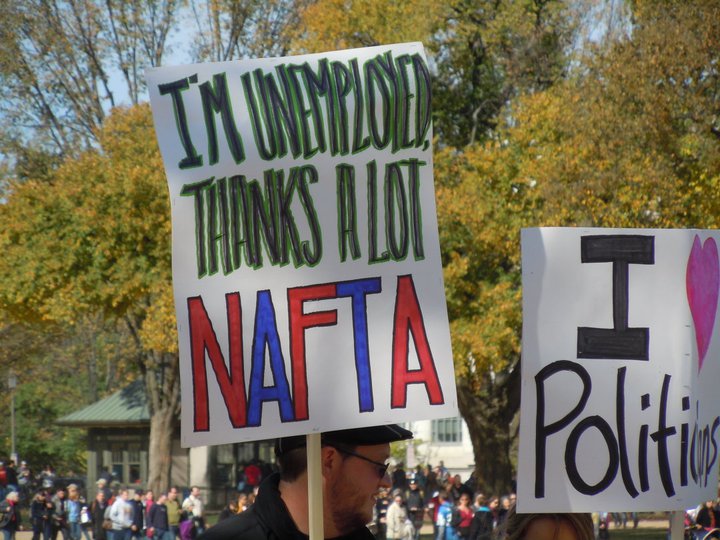
    Jon Stewart's big "Rally to Restore Sanity (and/or Fear)" drew hundreds of thousands of sign-waving lefty hipsters"moderates" to, according to Stewart himself, "work together" in order to "get through the darkness and back into the light."  I freely admit that I'm not exactly sure what that means (probably because this blog is part of the "problem"), but the whole thing seemed kinda, umm, vague, judgmental and directionless to me.  And if the sign below is any indication, it appears that not all of the rally's attendees were very well-informed about, you know, actual policy:


    Sigh.  Where to begin here.  Well, first let me say that I did in fact consider for a moment that our NAFTA victim here was being, like, totally ironic and stuff by mocking anti-NAFTA protesters in the same hilarious vein as South Park's "they took 'r jobs" gag.  But then I saw this sad-yet-telling-yet-comical video about the big rally and the economic education of its attendees, and realized that to assume that this anti-NAFTA sign is ironic humor is almost certainly to give this guy way, way too much credit:


    Now that's funny stuff.

    It also leaves me with little choice but to assume that this dude wasn't being super-ironic here, and thus to openly ponder how I should respond to his bold political statement.  I guess I could first point out the overwhelming evidence demonstrating that NAFTA has nothing to do with US job losses, but that would be way too simple (and probably go right over his trendy pageboy cap head).

    Or I could point out that maybe if he had spent half as much time, you know, looking for a job as he did on sign-making and concert-attending, he'd probably be employed right now.  But who knows: maybe he's networking at the rally or something. (Apparently federal government employees were at the rally attempting to add to their ranks - *shudder*.)  And anyway, that response sounds awfully curmudgeonly.

    No, I think the best response here is just to ask a very simple question:  Are we really to believe that THIS GUY's job went to Mexico/Canada via the NAFTA?  I mean, have tons of freelance blogger (comic book collector?) jobs been outsourced to Canada/Mexico that I don't know about?  Or is this guy just the most delicate unemployed autoworker on the face of the planet?

    I kid, I kid.  No, I'm sure that our brave NAFTA victim here had a very high-paying 'merican job that was unfairly outsourced to Canada and Mexico, and that we should therefore end all trade so that he can keep his job regardless of its actual value in the free market or the effects that such isolation would have on the US economy.  Then again, if we did that, he probably wouldn't be able to afford those glasses, that shirt or even that trendy pageboy cap.  And, of course, Ozzy Osbourne (a Brit) wouldn't be allowed to sing at the rally.

    But whatever.  NAFTA totally sucks, dude.

    You know, just like all that free trade with Keynesia.

    Thursday, October 21, 2010

    Quick Reminder: We're Still Paying Pointless Mexican Tariffs for Purely Political Reasons (and It Won't End Anytime Soon)

    I've repeatedly whined about lamented the Obama administration's refusal to resolve the US ban on Mexican trucks - one that was surreptitiously slipped into the 2009 Omnibus Appropriations Act at the behest of the Teamsters, expressly violates NAFTA and has resulted in the needless imposition of Mexican tariffs on over $2.4 billion worth of US exports annually.  Last time we checked in on this debacle of a dispute, things appeared to be moving at quite the, ahem, deliberate pace:
    Reuters reports on something that I unfortunately forecast months ago: the US-Mexico dispute over America's NAFTA-illegal ban on Mexican trucks won't be resolved for a long, long while.  Just how slow are things moving, you ask?  Well, on Monday, the two sides finally agreed to establish, in the words of Transportation Secretary Ray LaHood a "a working group to consider next steps of the cross-border trucking program."  In other words, after 14 months of Mexican retaliatory sanctions on $2.4 billion worth of US exports, the US and Mexico have finally agreed to form a bilateral group to talk about how to ultimately resolve the problem.  Eureka!  Of course, with 78 teamster-loving, perma-campaigning members of Congress openly demanding the renegotiation of NAFTA's liberalized trucking requirements, the administration's slow-walk of this dispute isn't really surprising.  Frankly, I'm just surprised that we didn't just try to pay the Mexicans off.
    Now, more than four months later, The Trucker reports that the Transportation Department has developed a new "fix" for the dispute, but - besides the fact that DOT said it had something ready to go more than a year ago  - there's a rather giant obstacle to implementing it:
    The Department of Transportation has developed a proposal that it feels can resolve the Mexico truck controversy, but is waiting until after the Nov. 2 election before discussing the plan when members of Congress, The Trucker has learned.
    Sources said the DOT is planning to move swiftly after the elections to push the proposal forward.
    In short, even though a solution to the NAFTA trucking mess appears to be ready, the Obama administration is refusing to move on it because of politics and nothing more; thus, American exporters will keep paying those pointless Mexican tariffs until DOT has been told by the White House that the electoral coast is clear.  Man, it's a good thing that the US economy is just humming along right now, or this political decision might be considered a pretty absurd, irresponsible and brazen move, huh?

    Oh, wait.

    Unfortunately, the news gets worse for those hapless American exporters (and their employees).  According to the Journal of Commerce (and re-reported above and here), it's very likely that DOT's big "fix" - which is almost certainly a temporary "pilot program" similar to the Bush-era program that the 2009 appropriations law cancelled - just ain't going to cut it anymore:
    Meanwhile, a Mexican official said Oct. 15 at a Washington luncheon that Mexico would not accept another pilot program as a solution, according to a report in the Journal of Commerce....

    "If you put in place a demonstration project similar to what we had, it can begin, but it can be defunded at any time,” said Jose Luis Paz Vega, the head of the trade and North American Free Trade Agreement office at the Mexican embassy in Washington said at the Oct. 15 luncheon. “Mexico is not willing to take that any more. We need a program that is permanent, that has certainty, and complies with NAFTA. And we’re not willing to accept anything less than that.”
    So even after elections, those tariffs aren't likely to go way anytime soon, and US exporters will keep paying through the nariz.

    Now, according to multiple sources, Washington Sen. Patty Murray (D) has been working, umm, "hard" to broker a solution to the Mexican trucking fiasco because many of her constituents are getting pummeled by the tariffs.  Yet she's been consistently stonewalled by Transportation Secretary Ray LaHood and the White House.  Of course, I do wonder just how hard Murray can really push on this issue considering she's complaining to her fellow Democrats.  I mean, I seriously doubt that she would be willing, for example, to demand congressional hearings on the subject and publicly grill Secretary LaHood live on C-SPAN, or to hold a news conference and scream about how dirty Teamster influence on the White House has threatened good Washington companies and jobs.  (Some quick Googling did reveal, however, that she wrote a sternly-worded letter to the President, drafted some legislative language on the subject, and politely asked Sec. LaHood for an "update" at a March 2010 hearing.  Shockingly, those bold and decisive moves didn't get the job done.)

    Fortunately for Sen. Murray's constituents, I imagine that her GOP challenger in next month's Senate election, Dino Rossi, wouldn't feel so conflicted about confronting the Obama administration, and thus could push a lot harder than Sen. Murray on this issue.  Maybe then, we could resolve this painful embarrassment once and for all.

    Thursday, August 26, 2010

    Umm, Yeah, About that "Dangerous" NAFTA Investment Thing...

    One of professional anti-traders' more, umm, "sophisticated" criticisms of US free trade agreements is that they create frightening new investment powers for foreign corporations.  In short, protectionists claim that "NAFTA-style" FTAs are just horrible because, among other things, they allow foreign corporations to challenge domestic health, consumer or safety regulations, and, if they win, to receive compensation from the offending government.  For example, here's Public Citizen on the US-Korea FTA:
    If the [Korea-U.S. FTA] were to go into effect, at least 79 Korea-based corporations with 270 establishments across the United States would obtain new rights to demand taxpayer compensation through challenges of U.S. federal, and state laws in foreign tribunals.
    Oooooh, scary!  Of course, what these fearmongering protectionists always fail to mention is that the FTA investment provisions that they're carping about are actually designed to encourage mutual investment in FTA partner countries - i.e., to help the countries give each other money for silly things like factories and jobs - by providing certain basic protections for that investment.  And against what exactly are these rules protecting, you ask?  Well, for one, they help discourage guys like Hugo Chavez from forcibly taking the land or facilities that a foreign company has fairly purchased because those rules would obligate ol' Hugo to compensate the company in the amount of its stolen investment.  The horror!  These rules also prevent governments from passing protectionist laws that will harm an FTA partner company's investment where the company proves that those laws are actually disguised restrictions on trade or violate due process.  For example, if American ScottCo buys a Mexican widget factory and then Mexico passes a "health regulation" prohibiting the domestic use of only ScottCo widgets (but not Mexican widgets), Mexico would have to compensate ScottCo where the company showed that the Mexican regulation had no rational, scientific basis.  And, of course, by seeing this type of sane, rules-based investment protection, companies like ScottCo are more inclined to invest in Mexico in the first place.

    Pretty sane and un-scary, huh?

    Unfortunately, the anti-trader's "investment canard" has become a real favorite of congressional protectionists. For example, here's Maine's favorite protectionist congressman, Mike Michaud (D), on the KORUS FTA in a 2009 letter to President Obama:
    While the Bush FTAs with Colombia, Panama, and Korea contain some improvements regarding labor and environmental standards relative to NAFTA, more work is needed on these and other provisions. Many of the most serious problems with the previous trade-agreement model are replicated in these FTAs. They must be renegotiated to ensure that these pacts at a minimum pass the most conservative “do no further harm” test.

    This includes the FTAs’ investment chapters, which afford foreign investors with greater rights than those enjoyed by U.S. investors. These three pacts’ foreign-investor chapters contain the same provisions in CAFTA that led many Democrats to oppose that pact, and that you cited as problematic during your campaign. Such provisions promote offshoring and subject our domestic environmental, zoning, health, and other public-interest policies to challenge by foreign investors in foreign tribunals.
    Gee, that sure sounds pretty bad.  Well, it isn't, and recent events surrounding two investor-state disputes in Canada have clearly demonstrated that protectionists' "investment canard" is really just a bunch of fear-mongering poppycock.  First, comes news that the Canadian government has settled with US-based AbitibiBowater after the province of Newfoundland seized Abitibi's land and assets:
    Canada agreed to pay AbitibiBowater Inc., the insolvent pulp and paper maker, C$130 million ($123 million) to settle a trade complaint after the government of Newfoundland and Labrador stripped the company of its timber and water rights in 2008....

    AbitibiBowater in February filed a trade complaint against Canada over what the company said was the illegal seizure of property by the provincial government in Newfoundland. At the time, AbitibiBowater requested C$500 million and filed the case under the terms of the North American Free Trade Agreement....

    With demand for newsprint falling, AbitibiBowater decided in 2008 to shut the Grand Falls-Windsor Mill in Newfoundland, which had operated for more than a century. Within two weeks of announcing that closing, the provincial government passed legislation stripping the company of its timber and water rights, according to the Nafta petition.
    In short, Newfoundland politicians got mad that a bankrupt US-based company was shuttering some of its Canadian facilities, so, instead of attempting to broker a reasonable compromise or just letting the market, you know, actually work as it's designed, the Newfie government forcibly seized AbitibiBowater's property without any compensation.  Fortunately for AbitibiBowater's creditors and investors, however, the company had legal recourse under NAFTA investment rules, and that led the Canadian government to provide fair compensation for the seized property (although C$370m less than the company wanted).  How, errrr, scandalous.

    Only a day later, however, the Canadian government came out on top in another NAFTA investment dispute, this one involving US chemical company Chemtura and new Canadian environmental regulations:
    The lawyers at the Department of Foreign Affairs and International Trade are not bragging about it—at least not to date—but they've just won an impressive victory in an $80 million-plus NAFTA lawsuit.

    Earlier this month, a panel of three arbitrators dismissed claims filed by the US chemical company Chemtura under Chapter 11 of the North American Free Trade Agreement.

    Chemtura had sought to hold Canada liable for financial losses related to the government's phase-out of lindane, a hazardous agricultural chemical. However, the company failed to persuade arbitrators that government regulators acted without regard for scientific evidence or due process.

    In addition to kicking Chemtura's claim to the curb, arbitrators also ordered the company to reimburse Canada for $3 million in legal costs and expenses.
    In short, Canada passed a law outlawing lidane,which Chemtura produced; Chemtura sued under NAFTA; and the arbitrator ruled in favor of Canada because Chemtura couldn't show that Canada's new law was unscientific.  I dunno about you, but that seems pretty rational (and deferential) to me.

    So to summarize, in the last week we've seen these horrible, scary NAFTA investment rules (a) lead to the fair compensation of a bankrupt US company whose lawful property was forcibly seized by the government in response to the company's routine (but unfortunate) commercial decision; and (b) uphold a Canadian environmental regulation and compensate the Canadian government for its legal expenses.

    Stop the insanity!

    Oddly, neither Congressman Michaud nor Public Citizen has commented on these excellent Canadian examples of the FTA investor-state provisions that they so detestenjoy bringing up.  Instead, Public Citizen's latest blog post scares us about - you guessed it - KORUS investment provisions.  (Because, you know, why focus on a silly thing like how these investment provisions actually work in practice?)

    Friday, May 7, 2010

    Friday Quick Hits: Headlines Edition

    I have a lot to share, so it's headlines-only today.  Yes, yes, I know: I'm lazy.  But hey, you're still getting your money's worth in this deal.

    Friday, April 16, 2010

    Friday Quick Hits

    The weekend's calling, so let's get right to it:
    • Someone in the administration actually knows that imports exist and aren't evil.  I've given this administration a lot of flak for its blinkered, mercantilist approach to US trade policy (and deservedly so, I might add).  But I've recently discovered evidence that at least one person working in the administration seems to get it.  The US Department of Commerce released a new study this week touting the value of  - big shock - exports to the US economy.  But buried deep in the report are actually two explicit references to the important role that imports play in the future health and prosperity of the US economy (and US manufacturing in particular).  Crazy, I know!  First, there's this on page 4: "The most important contribution of exports (and imports) to the U.S. economy is its role in increasing the industrial efficiency and standard of living of the United States."  And if that weren't exciting enough, check this out on page 8: "The growth in the ratio for goods exports was boosted by the productivity gains posted within the manufacturing sector and by the expanding—and important—role played by imports in manufactured goods."  Nice, huh?  Now, for a normal, economically-literate US administration, these two small references would not be a very big deal.  But for this White House - one whose 2010 Trade Agenda included not a single word about import benefits in almost 20 pages of text - this is a very exciting discovery.  (Now I know how Jane Goodall felt!)  So to Mr. John Tschetter (the report's author), I'd like to deliver my sincerest kudos.  I really hope that this little bit of publicity doesn't get you fired.
    • Benevolent USDA agrees to screw American consumers a smidge less.  Russ Roberts over at Cafe Hayek directs our attention to little-noticed news that the USDA will increase US quotas on imported sugar by about 300,000 tons (24%) this year.  Roberts is less-than-thrilled, and rightfully so: "What [the import-quota system] actually does is enrich a handful of families at the expense of the rest of us. It is a very ugly piece of public policy."  He goes on to point out that "the world price of sugar is about 17 cents a pound. Here in the US, we pay almost 31 cents, almost double."  I've noted previously how awful US sugar policy is, and I have little to add to Roberts' astute analysis, except for this one final thought: I love how USDA is trying to spin a small increase in sugar quotas as a "good thing" for US consumers.  Yes, it's better than the current quota amount, but saying it's "good" is like saying that punching me in the groin only 3 times is "good," because you had originally planned to punch me 5 times.  Gee, thanks, USDA.
    • Zombie protectionism continues to roam the earth.  Europe announced Thursday that it would resume retaliatory tariffs against the United States' use of the "Byrd Amendment."  The EU tariffs on 19 American exports will be set at 15% and will total about $96 million.  Ouch.  The EU first imposed the duties in April 2005 pursuant to the WTO's ruling that the United States’ distribution of antidumping and countervailing duties to domestic firms (instead of the US Treasury) under the Byrd Amendment (aka the Continued Dumping and Subsidy Offset Act or "CDSOA") violated WTO rules.  As I've noted previously, even though the WTO first ruled against the Byrd Amendment in 2001, and even though the US eliminated the program years ago, the duties are still being (illegally) disbursed;  Thus, countries like the EU and Japan continue to retaliate against American exporters.  The new EU sanctions will apply as of May 1, 2010.  There's been no word yet from the White House as to how exactly this boondoggle helps the President advance his new National Export Initiative (because it doesn't).
    • Zeroing violates WTO rules and US law.  Speaking of US non-compliance with global trade rules, Simon Lester over at the International Economic Law and Policy blog reports on a NAFTA panel ruling that the controversial US practice of zeroing, which the WTO repeatedly found inconsistent with global trade rules, also violates US law.  I can't wait to hear how protectionist congressmen and the AFL-CIO spin this one.  Oh, who am I kidding, I know exactly how they'll spin it - by declaring the entire NAFTA panel process illegitimate, of course! 
    Have a good weekend, everybody.

    Wednesday, April 14, 2010

    Wednesday Quick Hits

    I wish I could say I had a lot of good news today, but, well, I'd be lying.  So let's just give today's quick hits the Band-Aid treatment and rip 'em off as fast as possible:
    • Mexico, US Still Miles Apart on Trucking Dispute.  Reuters reports on something that I unfortunately forecast months ago: the US-Mexico dispute over America's NAFTA-illegal ban on Mexican trucks won't be resolved for a long, long while.  Just how slow are things moving, you ask?  Well, on Monday, the two sides finally agreed to establish, in the words of Transportation Secretary Ray LaHood a "a working group to consider next steps of the cross-border trucking program."  In other words, after 14 months of Mexican retaliatory sanctions on $2.4 billion worth of US exports, the US and Mexico have finally agreed to form a bilateral group to talk about how to ultimately resolve the problem.  Eureka!  Of course, with 78 teamster-loving, perma-campaigning members of Congress openly demanding the renegotiation of NAFTA's liberalized trucking requirements, the administration's slow-walk of this dispute isn't really surprising.  Frankly, I'm just surprised that we didn't just try to pay the Mexicans off.
    • US Promises on "Zeroing" Mean Zilch to Our Trading Partners.  BNA reports (subscription) that Vietnam and South Korea have officially lodged new WTO complaints against the United States' use of zeroing in antidumping investigations and reviews.  Those complaints are available here and here, and it appears that Vietnam is challenging the US practice in both original investigations and annual reviews, while Korea is challenging only original investigations.  As I've noted repeatedly, the US has been under constant fire for its use of zeroing, and it consistently loses on the issue at the WTO.  And while US officials have recently claimed that the administration will end the practice, they haven't done that yet, and America's trading partners obviously won't stop complaining until the practice is truly dead.  Indeed, as BNA notes, "The United States argues it cannot correct investigation results based on the illegal use of zeroing without a WTO case being filed by an aggrieved country.... Several countries, however, believe Washington has shown bad faith on the issue."  The result of US "bad faith," of course, is more WTO challenges like the Vietnamese and South Korean complaints, as well as eventual retaliation when the US loses and ultimately fails to comply with the WTO's rulings.  The EU has recently asked the WTO for permission to impose $311 million in retaliatory sanctions, and Japan might seek another $248.5 million in retaliation.  (Oh goody.)  Closing thought: given that the Korean complaint is only on original investigations, it's quite likely that the United States will "settle" the dispute quickly like it has in past cases.  The Vietnamese complaint, on the other hand, promises to be more interesting: if the US truly intends to end zeroing in both original investigations (which it did in 2007) and annual reviews, USTR would "settle" the Vietnamese case too, right?  Hmm.  Well, I don't know about you, but I'll believe it when I see it.
    • New Steel Pipe Duties Could Drill US-China Trade Relations (and Energy Prices!).  I've frequently stated that US trade remedies (antidumping and countervailing duty) actions against Chinese imports shouldn't be considered a good litmus test for US-China trade relations, but the latest Commerce Department ruling against Chinese imports of "oil country tubular goods" (human language: steel pipe used in oil and gas wells) is going to sting a little.  Why?  Well, as Reuters reports, this is the largest US case against Chinese imports ever - OCTG imports topped $1 billion in 2009 and $2.5 billion in 2008 - and anti-dumping duties ranged from about 30% to 100% (on top of countervailing duties of 10% to 15%).  That's a pretty big hit for Chinese exporters and, of course, US businesses and consumers.  Indeed, as Oil & Gas Journal indicates, the new duties will likely have rather painful consequences for American energy producers and drill pipe suppliers/retailers.  Considering that US natural gas producers (who use the targeted drill pipe) are one of the few American industries experiencing really good times right now, a ruling like this could significantly increase costs and thus blunt the impressive economic benefits coming from the booming US sector.  Just what our economy needs right now, eh?  Well, at least energy prices aren't climbing.  Oh, wait.

    Monday, April 5, 2010

    New Op-Ed: On Trade, It's Put Up Or Shut Up

    I have a new op-ed in The Daily Caller today.  I hope you like it; as always, your feedback is welcome.
    On trade, it’s put up or shut up

    With his signature health care legislation now law, President Obama has a little under three months to prove that he actually supports free trade. After that, all bets are off.

    By almost any metric, the Obama administration’s trade policy has been a disappointment. Inaction pervades, and our trading partners have gone from mildly annoyed to downright hostile. But the American trade agenda didn’t always look to be headed this way. In Spring 2009, the White House dramatically reversed the protectionist campaign rhetoric of then-Senator Obama. U.S. Trade Representative Ron Kirk launched an aggressive campaign advocating free trade and denouncing protectionism. The White House’s first Trade Policy Agenda called for ratification of the pending U.S.-Panama Free Trade Agreement “relatively quickly,” and sought to advance other completed FTAs with Colombia and South Korea. The Agenda also unequivocally supported the World Trade Organization and NAFTA, and anticipated congressional renewal of the President’s “fast track” trade negotiating authority.

    Then political reality set in.

    Immediately following the shift in White House trade rhetoric, congressional protectionists, almost all within Obama’s own Party, launched a stifling counter-offensive. Senator Sherrod Brown (D-OH), for example, expressed disappointment with USTR’s pro-NAFTA rhetoric and pledged to make it clear to President Obama that “our trade policy is not working and that it needs fixing.” Such comments proved effective. The White House abandoned overt free trade actions and speeches in order to secure needed health care votes from anti-trade Democrats – a move that Rep. Henry Cuellar (D-TX) apologetically confirmed at June 2009 Cato Institute event.

    As the health care debate stagnated, so did US trade policy, and it remains that way today. Signed FTAs remain shelved, despite the fact that the EU, China and others have negotiated preferential deals with the same FTA partners, each to the competitive disadvantage of American companies. The WTO’s Doha Round negotiations are comatose, even though an ambitious Doha deal would provide billions in benefits to US economy. And US exporters endure superfluous pains because the White House has failed to resolve several bilateral trade disputes, including $2.4 billion in Mexican tariffs resulting from the United States’ NAFTA-illegal ban on Mexican trucking, and the threat of almost $900 million in Brazilian sanctions based on US non-compliance with WTO rulings against American cotton subsidies.

    Despite these problems, some might argue that the National Export Initiative and the Trans-Pacific Partnership negotiations are concrete evidence that the Obama administration is dedicated to free trade. But real free trade policies – like the pending FTAs – involve immediate market liberalization at home and abroad. The NEI, by contrast, is a one-sided, non-controversial program which seeks to expand US exports through a timid combination of margin-tweaks that most economists believe will have little effect on US trade flows. Thus, calling the NEI “free trade” is like calling onanism “free love.”

    The TPP Agreement, on the other hand, could yield significant trade gains, but would take years complete. Indeed, USTR Kirk lauded the TPP negotiations precisely because they won’t be completed for years. Of course, this is the same USTR whose 2010 Trade Agenda mentioned the word “import” only five times, and never once in terms of domestic market access. So Kirk’s statements about the TPP and the administration’s advancement of the NEI are hardly surprising. They’re just par for the cowardly course.

    Throughout all of this, administration officials and the few free trade Democrats in Congress have quietly reassured the US business community that America’s free trade legacy will re-emerge once the contentious health care debate is over. In September 2009, Transportation Department officials told a concerned group of affected exporters that the White House would not resolve the Mexican trucking dispute because the President needed Teamster support for ObamaCare. And at an October 2009 event, Reps. Cuellar and John Tanner (D-TN) assured their audience that the FTAs would progress once the health care debate ended.

    Well, folks, health care’s over. Time to put up or shut up.

    Most of the United States’ current trade irritants are within the White House’s control to fix, as long as the President willing to expend an iota of political will to get things done. Signed U.S. FTAs have already been ratified by the partners countries and now only require the President to send their respective implementing legislation to Congress for ratification. While many congressional Democrats will resist such legislation, Obama can expect significant support from Republicans, many of whom, like House Trade Subcommittee Ranking Member Kevin Brady (R-TX), have routinely called on the President to submit the trade deals. Other issues show similar potential for bi-partisan resolution. All they require is an end to the White House’s politically-motivated ambivalence.

    In late June, Washington will turn its attention to the November mid-term elections, and controversial legislation will become untouchable. If President Obama and his free trade supporters really mean what they’ve said over the past year about the President’s commitment to free trade, the White House will move on one or more of the unresolved trade issues before this “silly season” begins.

    If, on the other hand, June comes and goes, and these issues are still unsettled because of the administration’s political calculations, then the die will have been cast. And no amount of excuses will be able to convince American businesses and consumers that this President really cares about free trade.
    *     *     *
    Bloomberg's Al Hunt strikes a similar note in his op-ed today.  I highly recommend giving it a look.